 Share
Share- Export to PDF
 Listen
The evolving landscape of emergency medicine training
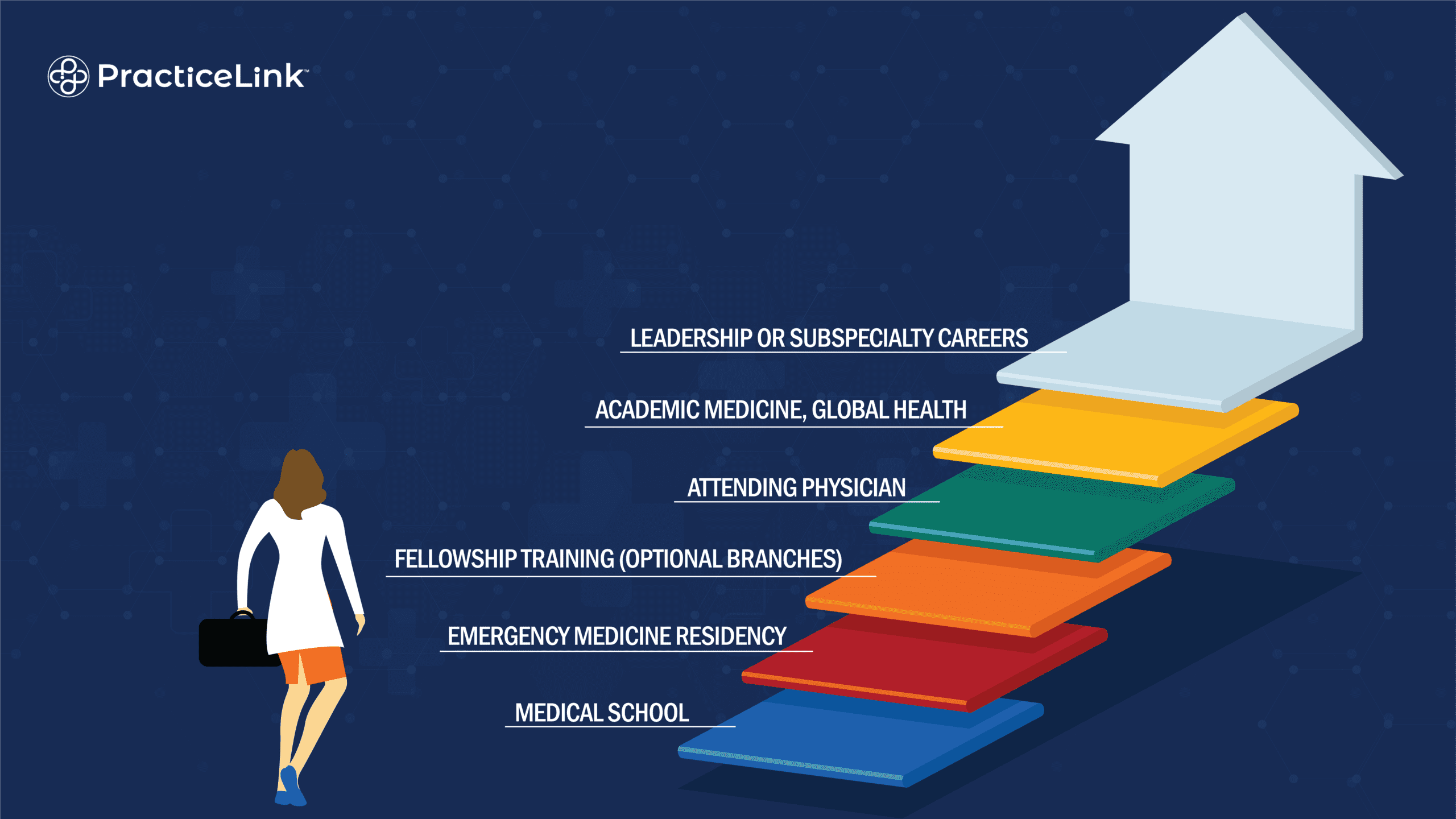
Emergency medicine (EM) is a dynamic and expanding specialty, but what exactly does it take to become the doctor making split-second decisions in the ER? The standard path to becoming an EM physician requires a bachelor’s degree, medical school, residency training, medical licensure and board certification through the American Board of Emergency Medicine (ABEM). Whether you are a prospective medical student or simply curious about how frontline healthcare workers are trained, here is a look at the current landscape of emergency medicine education.
How many emergency medicine residency positions are available in the U.S.?
Over the last two decades, emergency medicine training has seen massive growth. Between 2001 and 2023, the number of EM residency programs surged from 117 to 287, and available positions tripled from 1,001 to 3,010. While applicant interest dipped slightly in recent years, dropping to 2,765 in 2023, it has seen a strong rebound, reaching 3,574 in 2024 and 3,753 applicants in 2025. Today, the specialty continues to expand, with an AMA/FREIDA database in 2026 citing 3,185 first-year EM positions across the country.
What’s the difference between a 3-year and 4-year emergency medicine residency program?
Currently, the Accreditation Council for Graduate Medical Education (ACGME) accredits both 36-month and 48-month residency formats. A 36-month program condenses the core experience into three years, getting physicians into independent practice sooner. Conversely, a 48-month program spreads out the required 36 months of clinical education across four years, allowing extra time for electives, subspecialty exposure, research and building clinical confidence. Ultimately, the choice between the two formats currently comes down to institutional design and the educational goals of the resident.
However, a major paradigm shift may be on the horizon. In 2025, ACGME proposed an update aiming to make EM residency a universal 48-month program by July 2027. ACGME claims this change is necessary to accommodate new curricular “building blocks” and proposed requirements, but the move has proven highly controversial. Critics within the EM community argue the justification is weak and current evidence does not prove a universal four-year model yields superior educational outcomes.
Do EM fellowships improve academic and leadership career opportunities?
EM fellowships can improve both academic and leadership prospects, especially when you want a niche in education, research, administration, ultrasound, EMS, critical care or global health. SAEM says fellowship can give EM physicians a competitive edge for academic careers, while also helping build skills in scholarship, grant writing and teaching.
They can open doors to leadership roles. NYU’s Emergency Healthcare Leadership & Operations Fellowship is explicitly designed to prepare physicians for ED leadership positions, and Wake Forest’s leadership fellowship says it prepares EM-trained physicians for medical director and health system leadership roles.
Fellowships are not mandatory. SAEM notes many successful academic EM physicians never completed a fellowship, but fellowship training is increasingly valued by academic institutions because it creates a clear subspecialty niche and strengthens a candidate’s profile.
Even so, for physicians wanting to take their expertise to the next level, fellowships offer pathways into exciting subspecialties. Common options include pediatric emergency medicine, toxicology, ultrasound, critical care, global emergency medicine and EMS. These programs are specifically designed to prepare doctors for academic roles, research and leadership positions. By 2023, there were an estimated 157 ACGME-accredited EM fellowship programs, alongside many non-ACGME opportunities.
Top-rated programs are often identified by their breadth of options and strong institutional reputation. Heavyweights like Johns Hopkins, NYU Langone, The George Washington University and the University of Iowa boast extensive and varied fellowship portfolios.
What qualifications are needed for humanitarian or global emergency medicine work overseas?
The skills honed in the emergency department are highly sought after worldwide. Emergency physicians are “urgently needed” by international medical teams and humanitarian NGOs like Doctors Without Borders (MSF), International Medical Corps and the IRC.
This demand is especially strong in conflict zones, mass casualty events, outbreaks (like cholera or meningitis) and resource-limited settings requiring ED leadership. To qualify for these high-stakes humanitarian roles with MSF, physicians generally need to have completed their residency, hold a valid license and possess substantial post-residency experience.
How much do emergency medicine residents make during residency?
EM resident salaries are generally competitive with other residency programs, though they still vary mostly by region, institution and PGY level rather than by specialty alone. National resident-pay data in the sources reviewed put first-year resident pay around the mid $60,000s, with regional averages rising into the 70,000s depending on location.
EM resident pay
A recent resident salary source reports the average first-year medical resident earns $65,557, while another national summary puts the average resident salary at about $60,394; these figures are for medical residents in general, not EM specifically. For EM programs specifically, posted salaries show wide variation by institution and geography, with examples such as $62,540 for PGY-1 at one program and $89,261 at another, reflecting local market differences rather than specialty differences.
State variation
The clearest state-level resident salary data shows big differences by location, with averages ranging from about $46,323 in New Mexico to $65,889 in Maine – again across residents generally rather than EM residents only. This means a resident’s paycheck can look very different depending on where the program is, even when the training is the same.
Competitiveness
Compared with other medical residencies, EM pay is usually in the same general range, not dramatically better or worse. A 2024 resident salary report summarized by Healthgrades found an average resident salary of about $70,000, which is consistent with the idea that EM compensation during training is broadly comparable to other specialties at the resident level. The bigger financial distinction in EM tends to appear after residency, when attending salaries rise sharply.
Do EM fellowships pay more than residency, and is the extra training worth it?
Most emergency medicine fellowships pay at a fellow level, that is only modestly higher than residency—often in the rough PGY-4 to PGY-7 range. When compared to an EM attending, that extra stipend rarely offsets the income you give up by delaying attending-level compensation.
A 2024 survey showed that academic EM fellows earned a median annual total compensation of $93,853 in ACGME programs, while non-ACGME fellows earned slightly more at a median of $105,000.
The key issue is opportunity cost. A fellowship year can add training and credentials, making fellowships ideal for career reasons more than for immediate financial gain.
A fellowship may be worth it if it leads to a job you want and pays more or if it’s a required path into a niche like EMS, critical care, pediatric EM or academics. It can also make sense if you value protected time for research, leadership or a more specialized career track.
From the ongoing debates over residency length to the booming applicant numbers and the critical global demand for specialized skills, emergency medicine training is evolving rapidly. As the specialty continues to adapt, one thing remains clear: EM physicians are undergoing rigorous, specialized training to ensure they are ready for whatever comes through the emergency room doors.
For more information on emergency medicine residency and fellowship and to look for jobs in emergency medicine, visit PracticeLink.com.