 Share
Share- Export to PDF
 Listen
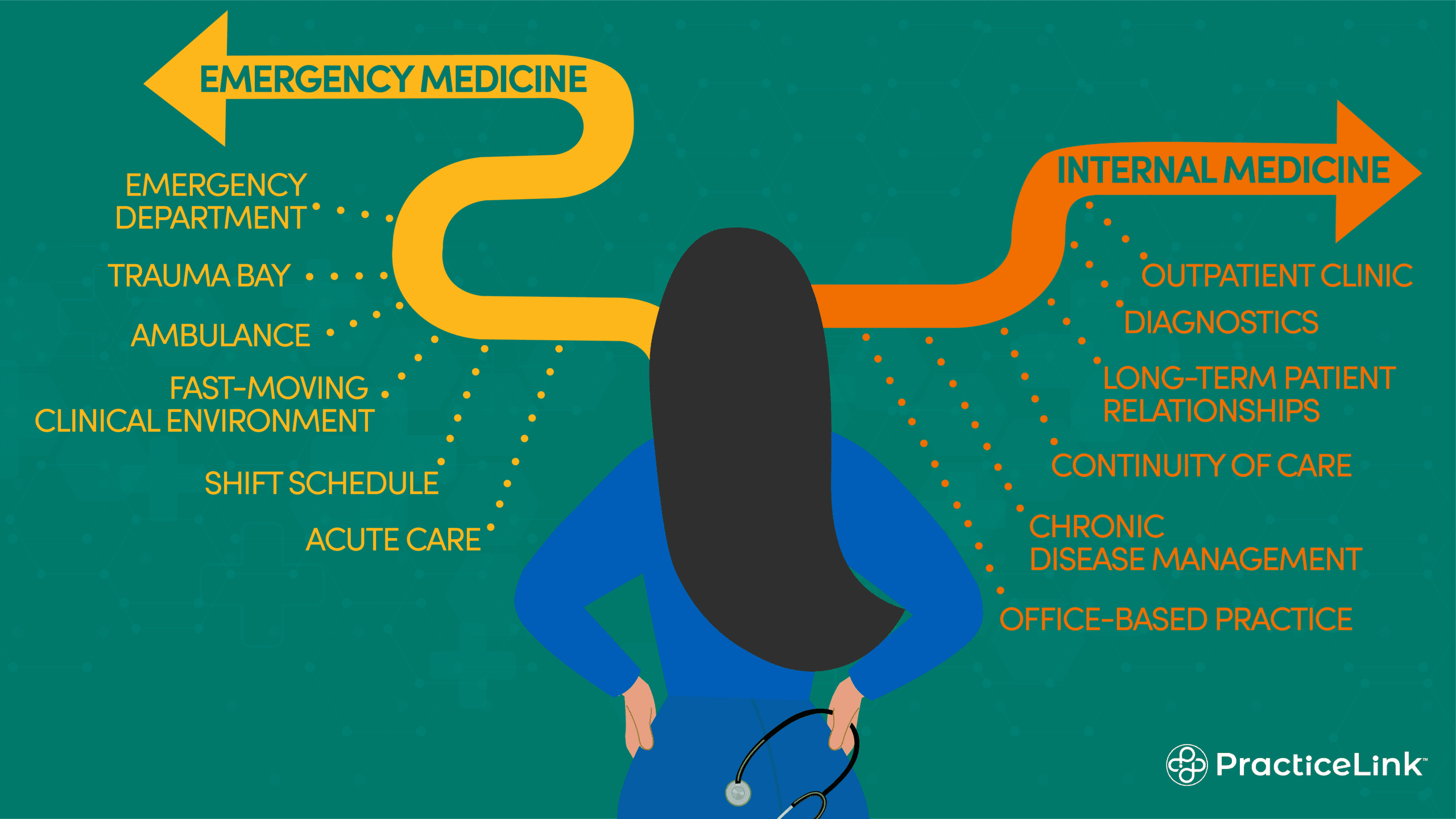
Emergency medicine vs. Internal medicine
For physicians, selecting a specialty is a pivotal decision. It determines so much about your career trajectory, your financial future and what work-life balance is going to look like.
For many medical students and residents, this decision includes a contrast and comparison of emergency medicine vs internal medicine. This often becomes a defining crossroads because both fields are essential to healthcare but offer very different day-to-day experiences, training paths and long-term lifestyles.
Although both specialties focus on adult patient care, they can greatly differ in pace, continuity and practice structure. Emergency physicians thrive in high-acuity, fast-moving environments, while internists tend to focus on diagnostic reasoning and longitudinal care. Understanding these differences can help medical students and residents choose a path aligned with their goals, values and preferred work environment.
What is the difference between emergency medicine and internal medicine?
The core difference in emergency medicine vs internal medicine lies in the type of care delivered. In simple terms, the ER doctor vs internist distinction comes down to:
- Emergency medicine: rapid, episodic, high-acuity care
- Internal medicine: longitudinal, comprehensive adult care
Emergency medicine focuses on immediate evaluation, stabilization and treatment of acute conditions, while internal medicine focuses on long-term diagnosis, management and prevention of adult diseases.
What does an emergency physician do?
An emergency medicine physician provides immediate care for patients with urgent or life-threatening conditions in emergency departments and related settings.
They treat a wide range of conditions, including trauma, chest pain, stroke symptoms, infections, overdoses and psychiatric emergencies—all in a single shift.
As noted by the American College of Emergency Physicians, “emergency physicians provide immediate decision-making and action necessary to prevent death or any further disability.”
Emergency physicians commonly work in:
- Hospital emergency departments
- Trauma centers
- Freestanding EDs
- Urgent care facilities
- Rural hospitals
- Academic centers
Their work often includes procedures such as intubation, central lines, sedation and fracture management, making emergency medicine physician roles highly procedural and fast paced.
What does an internal medicine physician do?
Internal medicine physicians specialize in the prevention, diagnosis and treatment of adult diseases. Their focus is typically longitudinal care – continuous, ongoing medical care to a patient over time, rather than treating only isolated illnesses or single episodes of care. As a result, they often develop long-term relationships with patients.
The American College of Physicians defines internists as physicians who apply clinical expertise to diagnose and manage adult disease with compassionate care.
Internal medicine physicians work in:
- Outpatient primary care clinics
- Hospitals (as hospitalists)
- Academic centers
- Subspecialty practices
- Telemedicine settings
They commonly manage chronic conditions such as diabetes, hypertension, COPD and heart disease. Many physicians pursuing internal medicine physician careers are drawn to continuity of care and diagnostic depth.
Which specialty sees more acute patients?
Emergency medicine sees a significantly higher volume of acute and unstable patients. These cases often require immediate intervention and rapid decision-making.
Internal medicine does treat acutely ill patients—especially hospitalists—but its broader focus includes chronic disease management and preventive care.
This distinction is central when comparing acute care medicine with inpatient medicine workflows.
How do residency training programs compare?
Residency structure is another key difference in emergency medicine residency vs internal medicine residency training.
Both provide broad exposure, but the focus and pacing differ significantly.
How long is emergency medicine residency?
Emergency medicine residency is typically three to four years.
Training includes rotations in:
- Emergency departments
- Trauma and critical care
- ICU
- Pediatrics
- Ultrasound
- Toxicology
- EMS
- Orthopedics and anesthesia
Residents build strong procedural skills, including airway management, resuscitation and trauma care.
Many pursuing emergency medicine residency value its intensity, variety and hands-on procedural training.
How long is internal medicine residency?
Internal medicine residency is generally three years.
Training includes:
- Inpatient wards
- ICU rotations
- Ambulatory clinics
- Subspecialty services
Common exposure areas include cardiology, infectious disease, endocrinology, nephrology and pulmonary medicine.
Unlike emergency medicine, internal medicine emphasizes longitudinal thinking, diagnosis and continuity of care.
Which residency is more competitive?
Both specialties are moderately competitive, though competitiveness varies by year and program.
Emergency medicine has experienced shifts in competitiveness due to workforce trends, while internal medicine offers more training positions overall, though top programs remain selective.
Competitiveness often depends on:
- USMLE/COMLEX performance
- Clinical evaluations
- Research and leadership experience
- Specialty demand trends
Ultimately, choosing between specialties should extend beyond match statistics into long-term career satisfaction.
Which specialty has better work-life balance?
Emergency medicine physicians often benefit from clearly defined shifts, which can make it easier to separate work from personal life once a shift ends. However, the tradeoff can be schedules frequently include nights, weekends, holidays and unpredictable hours that can disrupt sleep patterns and family routines. The fast-paced, high-intensity nature of emergency medicine can also contribute to emotional exhaustion, even when physicians are technically “off the clock.”
Internal medicine physicians, especially those in outpatient settings, may have more predictable daytime schedules and greater continuity with patients, which some physicians find personally rewarding. Additionally, internal medicine often comes with administrative responsibilities, charting, patient messages and follow-up tasks that extend beyond clinic hours. As a result, work-life balance in internal medicine can feel more stable on paper, but the boundaries between work and personal time may be less clearly defined.
Ultimately, the better work-life balance depends on the physician’s personality. Physicians need to ask themselves a few key questions, such as:
- What is my preferred schedule structure?
- How well do I tolerate shift work?
- Do I desire a more long-term relationship with my patients?
Do emergency physicians have more schedule flexibility?
Emergency physicians typically work shift-based schedules, which can provide predictable blocks of time off.
Potential advantages include:
- No outpatient inbox or follow-up burden
- Defined shift boundaries
- Flexible scheduling in some groups
- Opportunities for locum tenens work
However, challenges include:
- Nights, weekends and holidays
- Rotating shifts
- Circadian rhythm disruption
The emergency medicine lifestyle appeals to physicians who prefer leaving work at the hospital rather than carrying ongoing patient responsibility.
Do internists work fewer nights and weekends?
Internal medicine lifestyle varies by setting.
Outpatient internists typically work daytime clinic hours with limited overnight responsibilities, while hospitalists may work structured shifts such as 7-on/7-off schedules.
However, internal medicine physicians may spend significant time on:
- Documentation
- Patient messaging
- Refills and prior authorizations
- Care coordination
Compared to emergency medicine, internists often have fewer unscheduled nights but more administrative workload outside clinical hours.
Which specialty has higher burnout rates?
Burnout affects both specialties but stems from different pressures.
According to the American Medical Association, physician burnout involves emotional exhaustion, depersonalization and reduced professional satisfaction.
In emergency medicine, burnout is often associated with:
- High patient volume
- Shift work fatigue
- Boarding and crowding
- High-acuity stress
In internal medicine, contributing factors often include:
- Administrative burden
- Documentation demands
- Chronic disease complexity
- Productivity pressures
Burnout risk depends heavily on practice environment, support systems and schedule structure.
How do salaries compare between emergency medicine and internal medicine?
Compensation is another major factor in internal medicine vs emergency medicine salary comparisons.
While exact earnings vary by geography and practice type, emergency medicine physicians generally earn higher average compensation than outpatient internists.
Which specialty earns more?
Emergency medicine compensation is often higher due to:
- Shift work demands
- Acute care intensity
- Procedural responsibilities
Internal medicine compensation varies widely:
- Outpatient primary care tends to be lower
- Hospitalists typically earn more
- Subspecialists often earn the highest incomes
Factors influencing pay include RVU models, location and employment structure.
How does compensation vary by practice setting?
Emergency medicine pay can vary based on:
- Academic vs community hospitals
- Rural vs urban settings
- Contract models and shift volume
Internal medicine varies by:
- Primary care vs hospitalist roles
- Concierge or academic medicine
- Subspecialty training
Geography also plays a major role, with rural and underserved areas often offering higher compensation incentives.
Does fellowship training increase salary?
Internal medicine subspecialties often significantly increase earning potential, especially in fields like cardiology, gastroenterology and pulmonary/critical care.
Emergency medicine fellowships exist (such as critical care or toxicology), but salary increases are less predictable and often depend more on practice setting than subspecialty.
What personality traits fit each specialty?
Personality fit is often as important as compensation or training structure in the emergency medicine career path vs internal medicine career path decision.
Who thrives in emergency medicine?
Emergency medicine may be a strong fit for physicians who:
- Enjoy fast-paced environments
- Adapt well to uncertainty
- Prefer shift-based schedules
- Like procedures and acute care
- Work well in teams under pressure
It suits physicians who prefer episodic care rather than long-term relationships.
Who thrives in internal medicine?
Internal medicine tends to attract physicians who:
- Enjoy diagnostic reasoning
- Value long-term patient relationships
- Prefer continuity of care
- Are interested in chronic disease management
- Appreciate preventive medicine
It is often chosen by physicians who enjoy building sustained patient relationships over time.
What is the job outlook for emergency medicine vs internal medicine?
Both specialties remain essential to the healthcare system.
Emergency medicine jobs remain in demand due to:
- Rural hospital needs
- Trauma and acute care requirements
- Access gaps in underserved areas
Internal medicine jobs remain in high demand due to:
- Aging populations
- Chronic disease prevalence
- Primary care shortages
- Hospitalist expansion
Both specialties offer strong long-term career flexibility depending on practice setting and geography.
Which specialty should you choose?
Choosing between emergency medicine or internal medicine depends on how you prioritize lifestyle, patient interaction and clinical focus.
Emergency medicine may be a better fit if you prefer:
- Acute care and procedures
- Fast-paced decision-making
- Shift-based work structure
Internal medicine may be better if you prefer:
- Longitudinal patient care
- Diagnostic depth
- More structured daytime schedules
There is no universally “better” choice—only the best fit for your goals and work style.
The comparison of emergency medicine vs internal medicine highlights two distinct but equally vital physician career paths.
Emergency medicine emphasizes rapid stabilization, acute decision-making and shift-based practice. Internal medicine focuses on continuity, diagnostic reasoning and long-term disease management.
Both specialties offer meaningful careers, competitive compensation and strong job demand. The right choice ultimately depends on your personality, lifestyle priorities and long-term professional goals.
For physicians continuing to explore their options, it can be helpful to review:
- Emergency medicine jobs
- Physician compensation trends
- Residency training pathways
- Specialty lifestyle comparisons
Taking time to explore both paths through mentorship and clinical exposure can help ensure a confident and sustainable career decision.
To assist with that decision and others, the Physician Resource Center at PracticeLink.com offers information to help physicians navigate every stage of the career journey with trusted resources, specialty insights, compensation guidance and more. To search for emergency medicine jobs, visit our Job Search & Career Center.