
Meet Dr. Oluebube “Miracle” Okoye, First Practice Fund recipient
By PracticeLink July 21, 2026
 Share
Share- Export to PDF
 Listen
Meet Dr. Oluebube “Miracle” Okoye, First Practice Fund recipient
What does it take—and cost—to rebuild a career in a new system?
Before Oluebube “Miracle” Okoye first signed into the residents’ lounge at Arkansas Children’s Hospital, he had already completed an MBBS in Nigeria, finished two years of pediatric residency there and founded a hospital for families who otherwise might never see a doctor. He arrived in the United States as an experienced physician with a background of making independent bedside decisions, watching children survive against the odds and steeled from seeing others slip away from a combination of poverty and lack of access to medicine.
Starting over in the U.S. meant re‑entering training from the ground up.
When Dr. Okoye matched into a U.S. pediatric residency, he began again as an intern. He learned Epic instead of handwritten charts, memorized new referral pathways and quietly reconciled the gap between what he knew and what he was officially allowed to do.
Dr. Okoye is one of nine recipients of PracticeLink’s Spring 2026 First Practice Fund, a competitive scholarship which awards $2,500 to aspiring physicians and advanced practice providers.
As a First Practice Fund recipient, Dr. Okoye represents the intersection of international training and U.S. workflow, of global health and one-on-one patient care, of starting over and refusing to start from nothing. He was recognized for his extraordinary commitment to expanding healthcare access for underserved populations in the United States and abroad.
With Scion Health as a primary sponsor and Ballad Health and Navigate as program sponsors, the Spring 2026 First Practice Fund used a combination of essay questions and applicant CVs to identify high-caliber medical trainees poised to lead the future of community-based healthcare. Dr. Okoye’s commitment to improving access to quality care embodies the mission and values of the First Practice Fund.
PracticeLink: Describe a time you witnessed or experienced a barrier to healthcare access, how it shaped your perspective on medicine and how you envision addressing such barriers in your future career.
Dr. Oluebube Okoye: By the time a three-year-old boy and the seventh child in his family was carried by his parents into our ward in Nigeria, he had the look of marasmus I had only read about in textbooks — limbs like sticks, hair thinning and the sunken aged face clinicians call old man facies. At only three, he looked ancient. Poverty had done that.
The diagnosis was not the hard part. His parents could not afford admission. In Nigeria, healthcare runs almost entirely out of pocket — no insurance safety net, no Medicaid, no financial counselor down the hall. The barrier was not a broken system failing silently. It was standing right in front of me, in the form of a father who could not meet my eyes.
Access fails at the bedside, in a single moment, when a family has to choose between treatment and survival — quietly, without drama. If you are not watching, you miss it entirely. That experience changed how I understand the word “access.” I carry it with me now. Even in Arkansas, when a family misses follow up, skips a prescription or cannot act on dietary advice, I ask about the things behind the things — transportation, income, food on the table. Barriers here look different from Nigeria but the look on a parent’s face is the same.
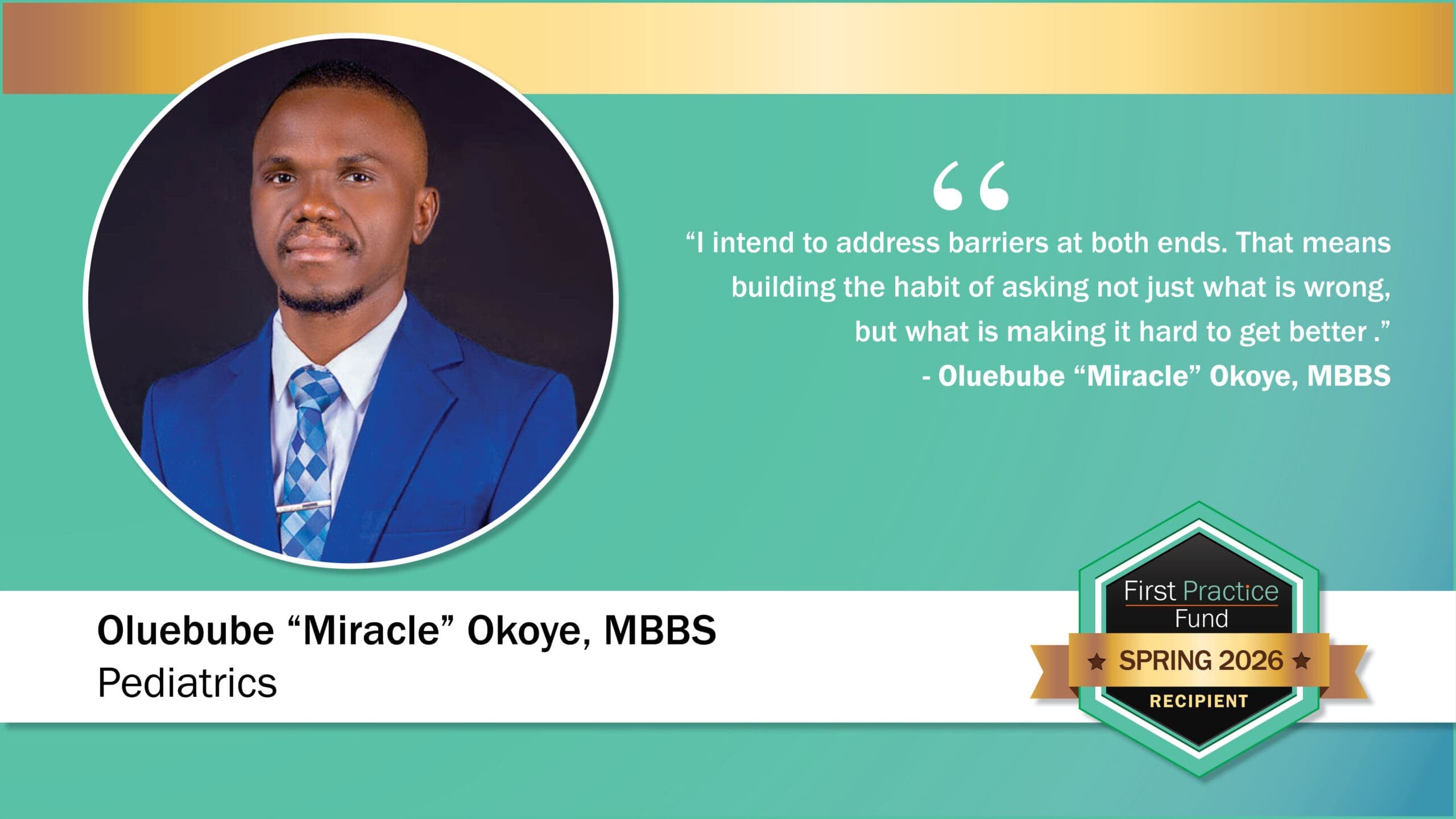
In my future career, I intend to address barriers at both ends. Clinically, that means building the habit of asking not just what is wrong, but what is making it hard to get better. Structurally, it means building institutions in underserved communities where quality care is actually reachable. I already run a clinic in Nigeria for exactly that reason. Good Shepherd Mirest Hospital exists, in no small part, because of a three-year-old boy whose family could not afford to save his life without strangers reaching into their own pockets.
I do not want that to be the solution. But I never want to stop being the kind of physician for whom it felt necessary.
PL: Share an example of meaningful collaboration across a care team. What made it successful, and what did you contribute?
DR. OKOYE: Caring for an adolescent with anorexia nervosa at Arkansas Children’s Hospital taught me what multidisciplinary care means in practice. It is a daily negotiation between specialties, each holding a different piece of a patient who is, in every sense, falling apart at once.
The team was large by necessity. Nutrition managed refeeding targets and monitored for refeeding syndrome. Psychology worked behavioral and cognitive dimensions that drove restrictions. Social work addressed family dynamics and home environment that would determine whether any inpatient progress survived discharge. BERT (an interdisciplinary hospital that responds rapidly when a patient’s behavior escalates to the point safety is at risk) was available when behavioral escalations made the unit unsafe. Each team came with their own language, their own priorities and their own sense of urgency.
My role as resident physician was to hold all of it together. That meant being present at every family meeting, synthesizing updates from each discipline into a coherent clinical picture and making sure competing recommendations — nutrition pushing calories up, psychology flagging the patient’s psychological readiness, family expressing fear — were heard, weighed and translated into a plan everyone could follow.
What made it work was honesty across the team. We disagreed, sometimes openly, about the pace of refeeding and the timing of passes home. Those disagreements, handled respectfully, produced better decisions than any of us would have reached alone. I learned to speak up when I thought the plan was moving too fast and to listen when psychology saw something I had missed on rounds.
The most meaningful collaboration I have experienced is one where everyone is genuinely heard and the patient is better for it.
PL: Describe a professional challenge you faced in training, how you responded and what you learned.
DR. OKOYE: When I matched into pediatric residency at Arkansas Children’s Hospital, I had already completed two years of residency training in Nigeria. I had managed acutely ill children, made independent clinical decisions and developed instincts that only come from time at the bedside. I knew none of that would carry over in title. I would be starting as an intern. I accepted that before I boarded the plane. What I was not fully prepared for was what it would feel like once I was actually here.
The challenge was not clinical medicine. It was the daily experience of having knowledge and experience that the system around me could not yet see. I knew how to assess a sick child. I did not know Epic. I did not know the referral pathways, the documentation expectations, the unspoken rhythms of how this particular team communicated. I was functioning at the level the title required while carrying the cognitive load of someone who had seen more than that title suggested. Reconciling those two things, quietly, every single day, was harder than I expected.
My response was to stay humble without becoming small. I asked questions without apologizing for not knowing. I did the intern work fully and without resentment because I understood credibility here had to be built from scratch regardless of what came before. At the same time, I did not pretend my prior training did not exist. When it gave me an edge in recognizing a clinical pattern, thinking through a differential or understanding what it looks like when a family has run out of options, I used it.
There are still days when the gap between what I know and what I am permitted to do independently feels wide. What I have learned is starting over is not the same as starting from nothing. The patience required to prove oneself in a new system, when you have already proven yourself in another, is its own kind of training. One I did not expect but one I am grateful for.
PL: Share your career goals and explain how First Practice Fund will help you achieve them.
DR. OKOYE: I am a pharmacist and physician from Nigeria, currently in my first year of pediatric residency at Arkansas Children’s Hospital. I left two years into Nigerian residency training to start over in the United States as an intern. This decision was right for my career and genuinely difficult in every other way. My goals are dual. In the U.S., I am building the clinical foundation to care for underserved children in Arkansas — patients navigating food insecurity, limited access and compounding social disadvantage. In Nigeria, I run Good Shepherd Mirest Hospital, a facility I founded to bring quality care to communities that lack it. My plan is to bring U.S.-trained pediatric expertise back to strengthen that work.
Residency as an international medical graduate, financially independent and building a career across two countries simultaneously, is expensive in ways that are hard to overstate. The First Practice Fund scholarship would directly ease that pressure and allow me to invest more fully in the training year that will define the physician I become — for patients in Arkansas and for patients in Nigeria who are waiting.

