
 Share
Share- Export to PDF
 Listen
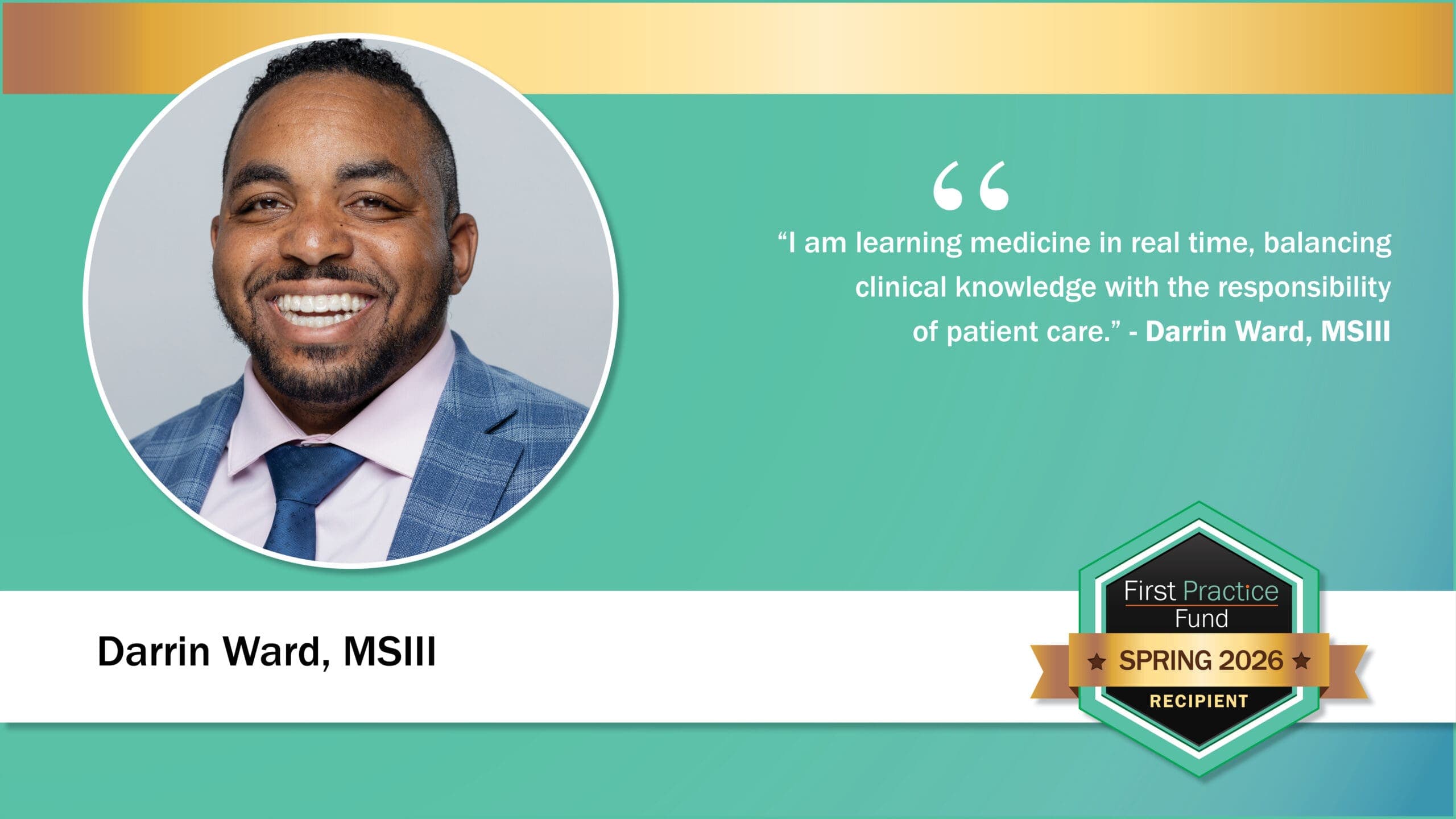
Meet Darrin Ward, First Practice Fund recipient
Darrin Ward is on the path to orthopedic surgery.
He’s moving toward a specialty that demands as much from a physician’s stamina as it does from well-honed skill in a field where years of training culminate the moment someone’s ability to walk, work or hold a grandchild rests in the surgeon’s hands.
The road to orthopedics is long and the need at the end of it is large. National projections show the number of orthopedic surgeons inching downward just as demand for their care climbs, with more than half of U.S. counties already lacking a single orthopedic surgeon.
Darrin is one of nine recipients of PracticeLink’s Spring 2026 First Practice Fund, a competitive scholarship which awards $2,500 to aspiring physicians and advanced practice providers.
Currently in medical school, Darrin was recognized for his dedication to advancing health equity, serving underserved communities and fostering the next generation of physicians. He has already demonstrated exceptional compassion, leadership and advocacy, recognizing effective healthcare extends beyond diagnosis.
With Scion Health as a primary sponsor and Ballad Health and Navigate as program sponsors, the Spring 2026 First Practice Fund weighed essay questions and applicant CVs to identify high-caliber medical trainees poised to lead the future of community-based healthcare. Darrin’s commitment and goals reflect a clear vision for making a lasting impact on patients and the broader community.
PracticeLink: Describe a time you witnessed or experienced a barrier to healthcare access, how it shaped your perspective on medicine and how you envision addressing such barriers in your future career.
Darrin Ward: Medicine is demanding, often humbling and rarely predictable. As a third-year medical student, I am learning medicine in real time, balancing clinical knowledge with the responsibility of patient care. I have performed CPR countless times, witnessing how the difference between life and death can depend on being in the right place at the right moment. These experiences have given me a deep respect for the fragility of life. Patients who were living ordinary lives just hours before can suddenly find themselves gasping for breath, seizing or hemorrhaging. Each day presents new challenges and new opportunities to show up for others.
One experience, however, challenged not only my assumptions about medicine but also my understanding of my role within it.
During a rotation, I admitted a woman in her fifties who presented after losing consciousness while using the restroom. She had experienced heavy, prolonged menstrual bleeding for nearly two years.
As I reviewed her history, I discovered she had visited the emergency department multiple times for similar symptoms. She had attempted to follow up with her OB/GYN but procedures were repeatedly delayed or canceled. She underwent a dilation and curettage (D&C), which revealed stage II endometrial cancer. Her diagnosis could have been made much sooner but was postponed by systemic gaps in care.
What followed was even more difficult to witness.
Before our team could arrange a formal conversation with her and her family, she was informed of her diagnosis while alone in her hospital bed. She received life-altering news without context, support or the presence of those she trusted most. When I entered the room, the weight of that moment was palpable. She was not just processing a diagnosis; she was processing her life. What will her life look like now? Will she still have time with her children and grandchildren? Would she need to make arrangements and prepare for the worst?
In that moment, I felt the limits of medicine. Clinical knowledge and technical skill were not enough to address what had just occurred. I stayed with her even after her family arrived, answering questions and praying with them. It was a small act, but it was what I could offer.
This experience reshaped my understanding of patient care. I had believed good medicine meant making the right diagnosis and providing the right treatment. While those remain essential, I now recognize how we care for patients is just as important as what we provide. Systems can fail. Communication can falter. In those gaps, patients are left vulnerable.
I began to see how clinicians become desensitized as a way to cope. While I recognize this, I am committed to resisting numbness.
After this, I became more intentional as a medical student. I often have more time than residents to sit with patients and families and review histories. When I see a red flag, I follow up to ensure it is addressed. Advocacy is often a series of small, persistent actions.
As I continue my training, I aspire to be more than a diagnostician. I want to be a physician who ensures patients are heard, supported and guided through a system that can feel impersonal. Medicine is unpredictable and deeply humbling because even when we have the knowledge to help, the system does not always allow us to do so. This experience reinforced my commitment to practicing with empathy, intentionality and accountability, even within an imperfect system.
PL: Share an example of meaningful collaboration across a care team. What made it successful, and what did you contribute?
DW: Since beginning medical school, I have intentionally sought opportunities to create pathways for those who will come after me while laying the foundation for my future in orthopedic surgery. Serving as external vice president of the Orthopedic Student Interest Group at Charles R. Drew University (CDU) of Medicine and Science has allowed me to combine leadership, service and advocacy in ways that reflect the physician I hope to become. In this role, I’ve recognized a critical need: students were seeking structured opportunities to develop practical skills, access mentorship and receive honest guidance on the path to orthopedic surgery.
Motivated by this need, I helped organize the first local chapter of Bridging the Gaps orthopedic outreach program at CDU. Designed to prepare medical students interested in orthopedics for their sub-internship rotations through hands-on bio skills stations and a candid faculty panel discussion on the orthopedic surgery match process. This effort brought together a multidisciplinary “care team” of orthopedic surgeons, trainees, industry partners and student leaders aligned around improving training and ultimately patient care. By equipping myself and fellow students with early procedural exposure and mentorship, we’ll be better prepared as future clinicians to deliver safe, effective orthopedic care.
While organizing the event, I reached out to numerous residents and physicians to participate. I was grateful for those who generously gave their time, those who communicated early when they were unable to attend and those who helped expand the network by connecting me with additional mentors. At the same time, I encountered challenges, delayed responses, last-minute changes and occasional lack of follow-through.
Navigating these situations required adaptability, persistence and professionalism. I learned to anticipate variability in communication styles, remain solution-oriented and continue building momentum without taking setbacks personally.
This experience also taught me how to recognize individual strengths and align them effectively within a team. By understanding how different contributors, physicians, medical students, industry representatives and faculty approach their roles, I was able to place individuals in positions where they could contribute most meaningfully. This intentional coordination helped ensure each team member felt valued while contributing to a cohesive and smoothly executed event.
To bring this vision to life, I secured $3,780 in sponsorship funding from Sutter Health and Dr. Nathan Ford, while coordinating additional support from Stryker to provide essential equipment for the bio skills stations. The collaboration was successful because of a shared mission to increase access, mentorship and diversity within orthopedic surgery, as well as clearly defined roles across the team. I served as the primary coordinator, aligning efforts between faculty, industry partners and student leadership to ensure effective communication and execution. The event ultimately welcomed 25 students in person, with an additional 15 participants joining the faculty panel via livestream. The enthusiasm and engagement from participants affirmed the importance of creating spaces where students can receive both practical preparation and meaningful mentorship.
This initiative would not have been possible without the support of Dr. Abdoulie Njai, who introduced Bridging the Gaps to CDU and entrusted me with leading its implementation. I am also deeply grateful to Sutter Health and Dr. Ford for their investment in our mission, as well as to the CDU OSIG executive board, whose efforts in promotion, setup and coordination were essential to the event’s success.
This experience reinforced a lesson I carry forward: while individual drive can create momentum, meaningful and lasting impact in medicine depends on strong collaboration.
PL: Describe a professional challenge you faced in training, how you responded and what you learned.
DW: During my first clinical rotation, I faced a challenge adapting not only to clinical medicine but also to the dynamics of working within a resident team. As a new medical student, I was learning to contribute effectively while also growing into a competent and confident future physician.
Midway through the rotation, the resident team changed and I encountered a mismatch in communication styles. The new team tended to give indirect, non-specific feedback, prioritizing maintaining a positive tone over providing actionable guidance. However, I learn best through direct, constructive criticism and actively seek specific ways to improve, which made it difficult to understand how to adjust my performance.
At the same time, I found myself in a challenging position regarding documentation. I initially wrote patient reports in the format preferred by the attending physician, who was also responsible for my evaluation. However, after submitting my notes, a resident modified them to match their preferred style. This created confusion, as the attending believed I was not incorporating feedback and perceived me as uncoachable. The situation was clarified after several days, when the resident acknowledged having made those changes.
Recognizing the potential impact on both my learning and evaluation, I took the initiative to address the issue directly but respectfully. I spoke with the resident team to better understand their workflow and asked how I could contribute without disrupting their efficiency. At the same time, I communicated my need for clear, actionable feedback and expressed concern about how the note modifications were affecting my evaluation.
Thankfully, the attending also observed the team dynamics and reached a practical solution. I began preparing notes tailored to the attending’s expectations, while adapting my submitted documentation to align with the resident team’s workflow. This approach improved clarity in expectations, allowed me to receive more meaningful feedback and ensured my evaluations accurately reflected my performance.
This experience taught me several important lessons. Effective communication and self-advocacy are essential in clinical environments, especially when expectations are unclear. I also learned the importance of adaptability when working with different team members, each with their own preferences and workflows. Moving forward, I will continue to seek clear expectations early and address challenges proactively to support both my learning and team effectiveness.
PL: Share your career goals and explain how First Practice Fund will help you achieve them.
DW: My short-term goals are to graduate from medical school, match into an orthopedic surgery residency and pursue a fellowship in sports medicine or joint reconstruction. Long term, I plan to return to South Los Angeles to serve the communities of Compton, Lynwood, Watts and South Central that shaped me. I aim to build a comprehensive orthopedic practice that integrates surgical care with physical therapy in one setting, emphasizing patient optimization before and after surgery through education, nutrition and movement to improve outcomes and long-term function.
I also hope to incorporate my passion for cooking into patient care by promoting practical, culturally relevant nutrition and sustainable lifestyle changes that can reduce the burden of chronic disease and enhance quality of life.
Beyond clinical practice, I am deeply committed to mentorship and community engagement. I plan to develop pipeline programs that provide underrepresented students with mentorship, academic support and early exposure to healthcare careers through structured, hands-on experiences. In doing so, I hope not only to care for my community, but to help build a future workforce that reflects and uplifts it.
By alleviating the financial burden of medical training, First Practice Fund will allow me to pursue my career path with by purpose rather than financial necessity, making it possible to return to and invest in an underserved community. Reduced debt would provide the mental freedom to fully dedicate myself to patient care, mentorship and community initiatives without the constant strain of significant loan obligations.
Equally important, this financial support would help lay the foundation for long-term stability in my personal life, allowing me to build a home, support a family and practice medicine without the persistent pressure of financial insecurity. Ultimately, a First Practice Fund scholarship from PracticeLink will empower me to pursue my professional and personal goals with clarity and intention, transforming my vision of sustainable, community-centered care into reality.

