
 Share
Share- Export to PDF
 Listen
Meet Karen Bishop, First Practice Fund recipient
There is a special kind of resilience that comes from decades of working in the margins of a healthcare system that would rather look away. Aspiring advanced practice provider Karen Bishop demonstrates that resilience. She brings to her training something no curriculum can teach: the memory of patients who were dismissed and the determination to do better by them.
A student at Saint Joseph College of Maine, Karen is one of nine recipients of PracticeLink’s Fall 2025 First Practice Fund. Applications are now being accepted for Spring 2026.
Sponsored by Premier Health, the Fall 2025 First Practice Fund combined essay questions and applicant CVs to identify high-caliber medical trainees who demonstrate clinical promise and an understanding of what it means to care for patients. Karen was recognized for her dedication to access, preserving dignity and innovative home-based care.
PracticeLink: Describe a time you witnessed or experienced a barrier to healthcare access, how it shaped your perspective on medicine and how you envision addressing such barriers in your future career.
Karen Bishop: While working in home care, I witnessed a recurring and painful barrier to healthcare access: older adults being written off simply because they required basic but high-touch care like suctioning, catheter maintenance or wound care. I heard physicians say, “They’re going to die soon anyway,” often without ever seeing the patient in person. What struck me most was that these were patients with treatable issues — not terminal illnesses — yet they were denied timely, dignified care because they couldn’t easily travel to clinics or hospitals.
This experience shaped my view of medicine in a fundamental way. I learned access isn’t just about insurance or location — it’s also about attitude. When providers assume frailty equals futility, patients lose the opportunity to recover, maintain quality of life or even simply feel human.
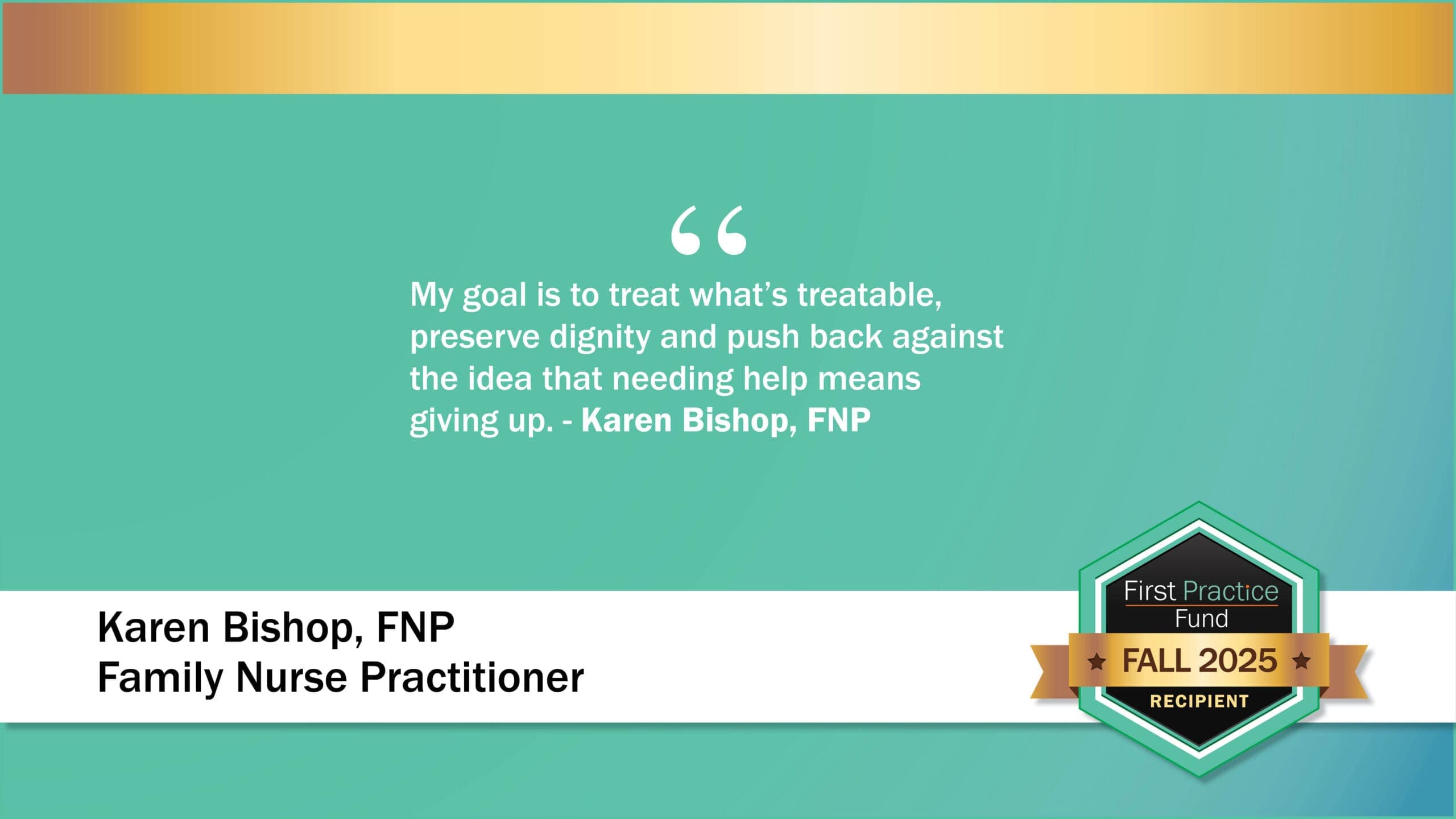
That’s why I’m committed to launching a house call practice for homebound seniors. I want to bring care to those who can’t easily come to it, and ensure they aren’t ignored by being labeled inconvenient or complex. My goal is to treat what’s treatable, preserve dignity and push back against the idea that needing help means giving up.
This scholarship would support that vision by helping me become the kind of provider who sees every patient as worth the time, effort and the respect of real care.
PL: Share an example of meaningful collaboration across a care team. What made it successful and what did you contribute?
KB: One of the most meaningful collaborations I’ve experienced has been through home care medicine. I believe home care is the best care because it allows us to see the patient in their own environment and build a care plan that’s truly holistic.
In one particular case, I coordinated services for a homebound patient recovering from a hospitalization. I ordered a home health aide, physical therapy, occupational therapy and social work — each professional contributed insight into the patient’s physical ability, safety risks, medication management and social support. We held case conferences, shared observations through the EMR and adjusted care in real time.
I also leaned heavily on the pharmacist, who reviewed the patient’s medications and made key recommendations that reduced polypharmacy and side effects. My role was to orchestrate the plan — to order services, communicate the clinical goals and remain available for adjustments.
What made the collaboration successful was mutual respect, clear communication and a shared goal of helping the patient regain independence. The patient went from being bedbound to walking with assistance — a direct result of team-based care.
My contribution was both clinical and logistical. After discussing the plan, I set it in motion, integrated the input of each team member and ensured continuity. It reminded me that no matter how skilled we are individually, the best outcomes happen when everyone contributes their piece to the puzzle.
PL: Tell us about a professional challenge you faced in training, how you responded and what you learned.
KB: One of the biggest professional challenges I faced during training was earning the trust of supervising physicians who didn’t initially believe in my clinical judgment. Despite decades of experience working in hospitals, including managing critical patients and coordinating care across departments, I found some MDs were hesitant to let me take the reins.
It was frustrating because I wasn’t new to patient care. I was new to their expectations. I responded by staying grounded, continuing to show up prepared and letting my work speak for itself. I learned to communicate more assertively and back up my assessments with clear clinical reasoning and evidence. Over time, physicians began to see that I wasn’t just “confident” — I was clinically sound, team-oriented and always focused on what was best for the patient.
The experience taught me that credibility in medicine isn’t just about what you know — it’s about how you show it. I learned to bridge the gap between experience and perception, and to meet hesitation with humility and persistence. It made me a better communicator and it deepened my respect for the collaborative nature of care — where trust is earned, not assumed.
PL: Share your career goals and explain how First Practice Fund will help you achieve them.
KB: My goal is to launch an independent house call practice for homebound and medically underserved seniors. I’ve seen firsthand how many older adults fall through the cracks of the healthcare system simply because they cannot get to a clinic or hospital. These patients deserve consistent, compassionate care where they live; and I want to be the one to provide it. I plan to build a mobile practice that delivers primary care, chronic disease management and preventive services directly into patients’ homes. My long-term vision includes integrating home health aides, physical therapy and pharmacy consultations into a coordinated care model. One of my immediate needs is reliable transportation — without it, I can’t get to the patients who need me most. This scholarship would help me overcome that logistical barrier so I can start serving my community as soon as possible.

