
 Share
Share- Export to PDF
 Listen
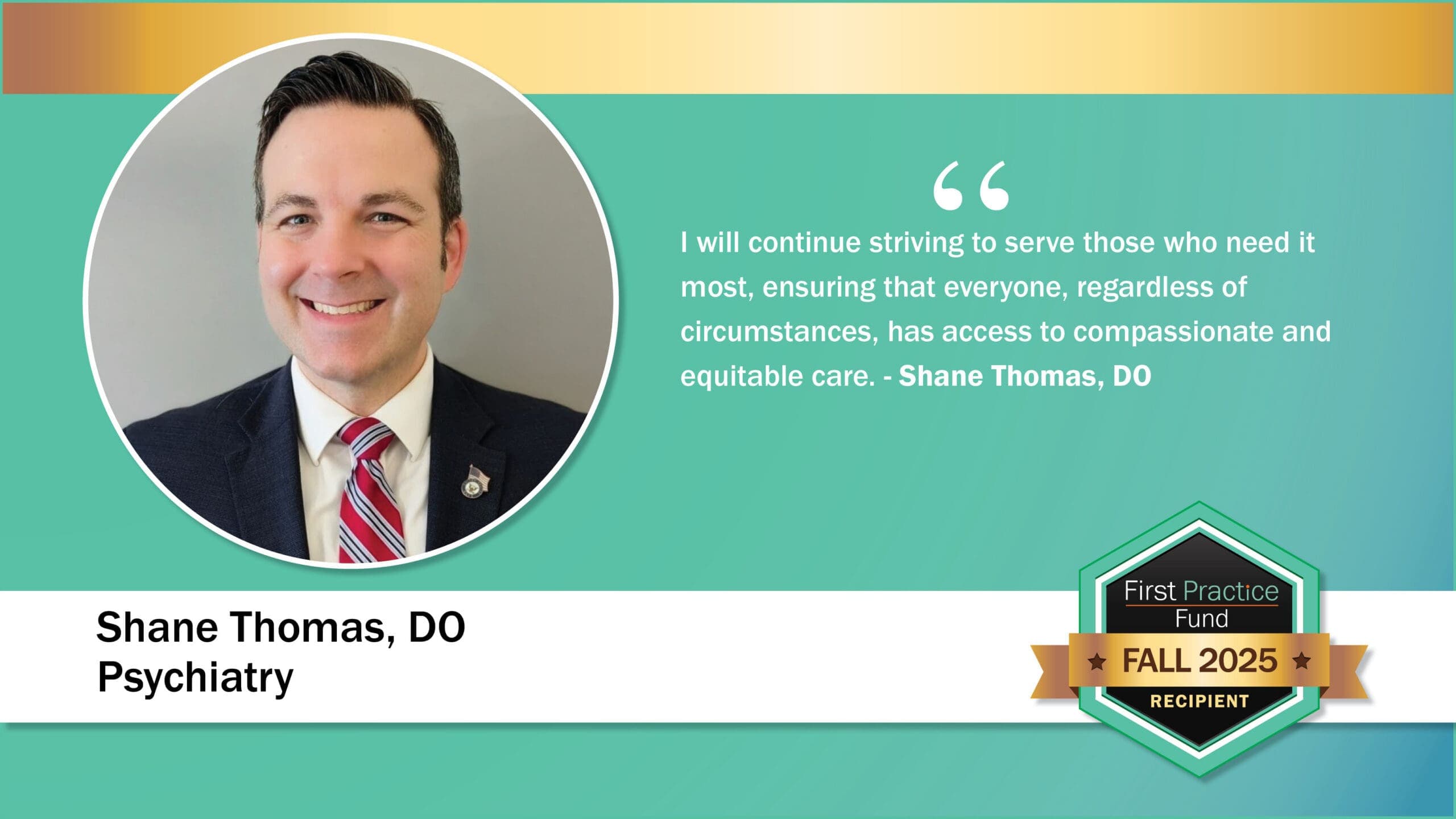
Meet Dr. Shane Thomas, First Practice Fund recipient
Providers in training often imagine where they might set up practice: maybe a big city, a rural community or their hometown. Aspiring psychiatrist Shane Thomas simply hopes to practice where the need is greatest. With a background in active-duty military service, Dr. Thomas built his training around the most underserved corners of the healthcare system: walk-in crisis centers, community health clinics and care teams navigating the complexities of homelessness, addiction and legal hardship.
Recognized for his service-driven mindset, intellectual humility, resilience and a willingness to grow, Dr. Thomas is one of nine recipients of PracticeLink’s Fall 2025 First Practice Fund. Applications are now being accepted for Spring 2026.
Sponsored by Premier Health, the Fall 2025 First Practice Fund combined essay questions and applicant CVs to identify high-caliber medical trainees who demonstrate clinical promise and an understanding of what it means to care for patients. Dr. Thomas’s career arc tells a consistent story of purpose and a clear drive to continue serving those who need it most.
PracticeLink: Describe a time you witnessed or experienced a barrier to healthcare access, how it shaped your perspective on medicine and how you envision addressing such barriers in your future career.
Dr. Shane Thomas: In my psychiatry training I worked at a community mental health center in Kansas City, MO, as part of my rotations. It was a privilege to work at a health crisis center that accepts patients on a walk-in basis, where patients could find psychiatric care and care for ongoing struggles with substance use.
That experience had a profound impact on my choice to continue to work at a facility where patients are never turned away regardless of ability to pay and is often the only inflow to medical care many patients receive. As a result, I often put on multiple hats including primary care physician, and also heavily lean on case managers and nurses for follow-up resources to best help with patients. This also changed my practice goals to pursue addiction psychiatry.
PL: Share an example of meaningful collaboration across a care team. What made it successful and what did you contribute?
DR. THOMAS: I continue to work at state facilities and community mental health centers in Kansas City and frequently meet with challenging psychosocial cases including homelessness, patients with legal charges, patients with substance use and other complex medical needs. Working here, I would never be able to serve all of my patients or meet all other needs if I were working alone. Thankfully I have the assistance of a diverse care team to collaborate with including social workers, case managers, nurses and pharmacists to help fully care for these patients.
PL: Tell us about a professional challenge you faced in training, how you responded and what you learned.
DR. THOMAS: I served as an active-duty physician in the US Navy before taking care of poor and impoverished Spanish-speaking patients at community health centers. This was a dramatic challenge for me because not only were the overall patient’s less physically healthy than patients I cared for in the Navy, but appointments were more demanding because they were significantly shorter and hindered due to me not being fluent in Spanish. While I felt a strong desire to serve these underserved patients, it was an extremely challenging and often overwhelming time in my career. Ultimately, I was able to adapt by becoming proficient in medical Spanish. This trial led me to becoming a more competent and adept physician overall.
PL: Share your career goals and explain how First Practice Fund will help you achieve them.
DR. THOMAS: Addiction psychiatry while also working in general psychiatry; possibly with a substance use clinic or with the VA.
PracticeLink’s First Practice Fund speaks directly to my experiences and aspirations. Financial support has always been a limiting factor in my education. My father, an immigrant refugee from the Vietnam War, worked as a low-wage laborer and could offer little financial assistance. Receiving this scholarship would not only ease my financial burden but also affirm the path I have taken. With this support, I will continue striving to serve those who need it most, ensuring that everyone, regardless of circumstances, has access to compassionate and equitable care.

