Cardiology career paths, training and job opportunities
By Georgia Scott August 22, 2026
 Share
Share- Export to PDF
 Listen
Cardiology career paths, training and job opportunities
Cardiology career paths can unfold in many directions, shaped by the patients you want to serve, the problems you feel called to solve and the kind of life you want your work to support. One physician spends her days threading catheters through coronary arteries in a high-stakes cath lab; another builds years-long relationships with heart failure patients in a quiet outpatient clinic; a third reads echocardiograms from dawn until dusk, rarely touching a patient at all.
Cardiology isn’t a single profession—it’s a constellation of subspecialties, each with its own rhythm of patients, procedures, technologies and work environments. The path you choose won’t just determine what you do each day; it will shape your training, your call schedule, the balance between hospital and clinic and career opportunities that open up for decades to come.
PracticeLink helps physicians explore cardiology opportunities across specialties, practice settings and locations nationwide so they can better understand where their training and career goals may lead.
As you consider your next step, resources such as cardiology career path and cardiologist salary can provide additional context.
What are the main cardiology subspecialties?
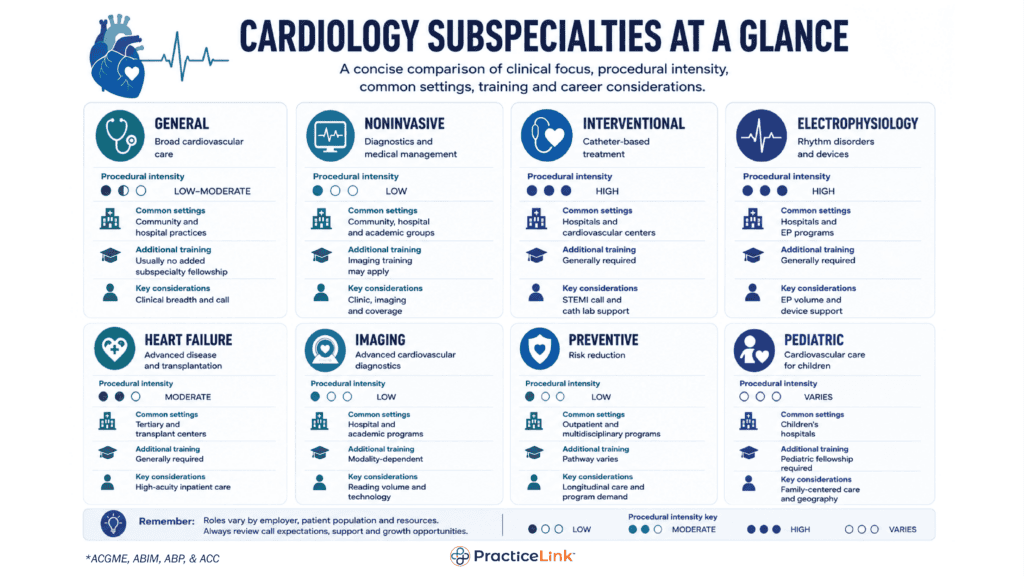
The major cardiology specialties include general cardiology, noninvasive cardiology, interventional cardiology, clinical cardiac electrophysiology, advanced heart failure and transplant cardiology, structural heart cardiology, cardiac imaging, preventive cardiology and adult congenital heart disease.
Some cardiologists enter general or noninvasive practice after completing an internal medicine residency and cardiovascular disease fellowship. Others complete an additional subspecialty fellowship to develop expertise in interventions, heart rhythm disorders, transplantation or another focused area.
Training and board certification requirements can change. Physicians should verify current standards with the Accreditation Council for Graduate Medical Education (ACGME), American Board of Internal Medicine (ABIM), American Board of Pediatrics (ABP) and individual accredited programs. ABIM maintains separate certification pathways for cardiovascular disease, interventional cardiology and clinical cardiac electrophysiology, while the ABP currently requires three years of accredited pediatric cardiology fellowship training for pediatric cardiology certification.
General cardiology
General cardiologists diagnose and manage a broad range of cardiovascular conditions, making this one of the most clinically diverse cardiologist specialties.
What general cardiologists do
Responsibilities of general cardiologist may include outpatient cardiovascular care, inpatient consultations, diagnostic testing, chronic disease management, cardiovascular prevention and coordination with cardiology subspecialists. General cardiologists often build long-term relationships with patients managing hypertension, coronary artery disease, valvular disease and other chronic conditions.
Common practice settings
General cardiologists work in hospitals, private practices, multispecialty groups, academic medical centers and rural or regional healthcare systems. Their broad scope can be especially valuable in communities without extensive subspecialty coverage.
Career considerations
Consider the expected balance of inpatient and outpatient practice, referral relationships, clinic volume and call responsibilities. Some positions require broad general coverage, while others allow physicians to develop focused interests.
Explore general cardiology jobs to compare opportunities.
Noninvasive cardiology
Noninvasive cardiologists diagnose and treat cardiovascular disease without performing catheter-based or surgical procedures.
What noninvasive cardiologists do
Their work may include outpatient consultations, inpatient care, echocardiography, stress testing, ambulatory monitoring and medical management. Some positions combine general cardiology with advanced cardiac imaging responsibilities.
Career considerations
Evaluate clinic and reading volume, inpatient coverage, imaging expectations and call. Noninvasive cardiology jobs are found in community practices, hospital-employed groups and academic programs, but responsibilities can vary substantially.
Interventional cardiology
Interventional cardiologists perform catheter-based procedures to diagnose and treat cardiovascular conditions.
Common procedures and responsibilities
Responsibilities may include coronary angiography, percutaneous coronary intervention, cardiac catheterization, acute myocardial infarction care, inpatient consultations and post-procedure management.
Training and certification
Interventional cardiology generally requires additional accredited training after cardiovascular disease fellowship. Physicians should confirm current program and ABIM eligibility requirements because certification standards and procedural competency expectations may evolve.
Career considerations
Ask about procedural volume, STEMI call, cath lab resources, nursing and technical support, surgical backup and quality expectations. Because emergency procedures can create schedule unpredictability, call structure is an important part of evaluating interventional cardiology jobs.
Clinical cardiac electrophysiology
Clinical cardiac electrophysiologists diagnose and treat conditions involving the heart’s electrical system.
Common procedures and responsibilities
Their work may include electrophysiology studies, catheter ablation, pacemaker and defibrillator implantation, cardiac device monitoring and longitudinal management of arrhythmias and other heart rhythm disorders.
Training and certification
Clinical cardiac electrophysiology typically requires advanced fellowship training beyond cardiovascular disease fellowship. ABIM maintains a dedicated certification pathway that evaluates the knowledge, diagnostic reasoning and clinical judgment expected within the field.
Career considerations
Evaluate electrophysiology (EP) lab access, ablation volume, device clinic support, referral networks, technical staffing and call. The role may combine intensive procedural work with long-term patient relationships.
Advanced heart failure and transplant cardiology
Recent data from Centers for Disease Control estimate about 6.7 million U.S. adults over the age of 20 are living with heart failure, with projections rising further over the next decade. Advanced heart failure and transplant cardiologists care for these patients, including roughly about 1 in 10 heart failure patients with complex or advanced disease.
Common responsibilities
Responsibilities include advanced heart failure management, transplant evaluation, mechanical circulatory support, ventricular assist device care, inpatient critical care and multidisciplinary patient management.
Common practice settings
Most opportunities are based in academic medical centers, transplant centers, tertiary-care hospitals and large cardiovascular programs with the resources to support high-acuity care.
Career considerations
Consider inpatient demands, call, program resources and access to multidisciplinary teams. These careers may also offer opportunities in teaching, research and program development. ACGME’s current framework treats advanced heart failure and transplant cardiology as a one-year fellowship pathway, although physicians should verify requirements before applying.
Structural heart cardiology
Structural heart disease (especially valve disease) affects about 2.5% of the U.S. population and more than 10% of adults over age 75. Structural heart cardiologists focus on catheter-based treatment of heart valves and other structural conditions.
Common procedures and responsibilities
Their work may include transcatheter aortic valve replacement, transcatheter valve repair, left atrial appendage closure, structural heart imaging, multidisciplinary case review, patient selection and follow-up care.
Career considerations
The opportunity depends heavily on program maturity, procedure volume, institutional investment, credentialing, imaging support and collaboration with cardiac surgery. Ask whether the organization has an established multidisciplinary heart team and a sustainable referral pipeline.
Cardiac imaging
Several advanced imaging and AI-enhanced tools are used to evaluate cardiovascular structure and function, including advanced echocardiography, high-resolution CT and CT-FFR, cardiac MRI innovations, nuclear and PET-based functional imaging, AI-enhanced ECG and imaging, as well as biomarkers and precision diagnostics. Imaging-focused cardiologists use advanced diagnostic tools to evaluate cardiovascular structure and function.
Major cardiac imaging areas
Major areas include echocardiography, nuclear cardiology, cardiac CT, cardiac MRI and structural heart imaging. Some physicians concentrate on one modality, while others maintain multimodality expertise.
Training and certification
Physicians may pursue additional training or certifications depending on the modalities they intend to interpret and the credentialing standards of prospective employers.
Career considerations
Ask about protected interpretation time, reading volume, equipment, support staff and the expected mix of imaging and clinical practice. Academic positions may also incorporate teaching and imaging research.
Preventive cardiology
Preventive cardiologists work to reduce cardiovascular risk and slow disease progression.
Common responsibilities
Their responsibilities may include lipid management, hypertension management, cardiovascular risk assessment, lifestyle counseling, obesity-related cardiovascular care and long-term disease prevention.
Career considerations
Preventive cardiology commonly includes substantial outpatient care, longitudinal patient relationships, population health and multidisciplinary collaboration. Schedule characteristics still depend on the employer, patient population and additional general cardiology responsibilities; preventive cardiology should not automatically be assumed to offer a predictable lifestyle.
Adult congenital heart disease
There are roughly 1.4–1.6 million adults with congenital heart disease in the U.S., yet only a few hundred board‑certified ACHD specialists and just over 100 dedicated clinics. Adult congenital heart disease specialists care for adults born with structural heart conditions.
Common responsibilities
Their work includes lifelong congenital heart disease management, imaging, surveillance, pregnancy-related cardiovascular planning and coordination with pediatric cardiology, cardiac surgery and interventional teams.
Career considerations
Opportunities are often concentrated in academic or tertiary centers with specialized teams and regional referral networks. Additional training and certification requirements should be confirmed through current accrediting and certifying organizations.
Emerging and focused areas of cardiology
Some physicians develop focused practices that do not always represent separate, board-certified cardiovascular subspecialties. Training and credentialing pathways differ.
Cardio-oncology
Cardio-oncology addresses cardiovascular risks and complications among patients receiving or recovering from cancer treatment.
Sports cardiology
Sports cardiology focuses on cardiovascular evaluation, risk assessment and care for competitive athletes and highly active patients.
Critical care cardiology
Critical care cardiologists manage patients with severe cardiovascular illness in cardiac intensive care settings, often in collaboration with critical care, heart failure and interventional teams.
Women’s cardiovascular health
This area addresses cardiovascular conditions, symptoms and risk factors that may present differently or require focused expertise in women.
Pulmonary hypertension
Pulmonary hypertension (PH) is uncommon compared with heart failure or coronary disease but still affects tens to hundreds of thousands of adults. Pulmonary hypertension specialists diagnose and manage complex pulmonary vascular conditions within multidisciplinary programs.
Explore the future of cardiology and cardiology career opportunities.
Pediatric cardiology
Pediatric cardiology is both highly important and reasonably common in the U.S., where congenital heart disease is the most frequent class of birth defects. There are thousands of pediatric cardiologists, most of whom entered through pediatric residency training rather than internal medicine.
What pediatric cardiologists do
Pediatric cardiologists care for children with congenital heart disease, rhythm disorders, heart failure and other cardiovascular conditions. Their work may involve fetal cardiology, cardiac imaging and family-centered care.
Pediatric cardiology subspecialties
Focused areas include pediatric electrophysiology, interventional pediatric cardiology, fetal cardiology, pediatric heart failure and transplantation and adult congenital heart disease.
Career considerations
Consider pediatric-specific training, family communication, specialized referral networks and the concentration of opportunities within children’s hospitals and academic centers. The ABP currently requires three years of full-time, broad-based accredited pediatric cardiology fellowship training for certification eligibility.
Explore pediatric cardiology jobs, types of cardiologists and cardiology career paths.
How do cardiology subspecialties compare?
No comparison can determine the best or highest-paid cardiology specialty for every physician. Compensation, responsibilities and satisfaction depend on practice setting, geography, call, productivity and professional priorities.
Procedural versus nonprocedural cardiology
Procedural fields often involve greater dependence on specialized laboratories, technical teams and emergency coverage. Nonprocedural paths may include more clinic, diagnostics and longitudinal management, although they can still carry substantial inpatient and call responsibilities.
Inpatient versus outpatient focus
Heart failure, interventional and critical care roles may include more hospital-based care. Preventive and some noninvasive positions may have a larger outpatient component. Actual responsibilities should always be confirmed with the employer.
General versus highly specialized practice
General practice may provide broader geographic flexibility and clinical variety. Highly specialized practice can offer concentrated expertise and advanced technology but may depend more heavily on referral volume and institutional resources.
Which cardiology subspecialty is right for you?
You are the decision maker. The right path is the one that supports the physician and person you want to become.
Consider your clinical interests
Ask whether you prefer broad or focused care, procedures or medical management, acute or longitudinal care, diagnostics or interventions and adult or pediatric populations.
Consider the work environment
Picture yourself in academic medicine, community practice, inpatient care, outpatient care, a large multidisciplinary program or a smaller independent group.
Consider schedule and call
Evaluate night and weekend call, emergency procedures, inpatient coverage, clinic volume, schedule predictability and shared-call arrangements. Review cardiologist work-life balance and the typical cardiologist schedule before accepting assumptions about any specialty.
Consider long-term career goals
Think beyond your first position. Leadership, research, teaching, program development, private practice ownership and geographic flexibility can become increasingly important over time.
Seek direct experience and mentorship
Use elective rotations, fellowship exposure, mentorship and informational interviews to understand how a specialty operates in different settings. Conversations with practicing physicians can reveal details job titles cannot.
How cardiology subspecialty affects your job search
Your subspecialty can influence the number, location and type of positions available.
Job availability by subspecialty
Demand depends on population size, referral volume, hospital capabilities, existing specialists, competition and the employer’s service-line goals. Broad physician-shortage statistics should not be treated as proof of a shortage within a specific cardiology subspecialty.
Geographic flexibility
General and noninvasive opportunities may be available across a broader range of communities, while highly specialized programs may be concentrated in larger systems or academic centers. This is a market tendency—not a universal rule.
Questions to ask prospective employers
Ask prospective employers:
- What percentage of the role will focus on my subspecialty?
- Will I also provide general cardiology coverage?
- What procedure or patient volume is available?
- How are referrals generated?
- What facilities and support staff are available?
- What are the call expectations?
- Is the organization expanding the program?
- How will productivity be measured?
- Is protected time available for research, teaching or imaging?
If you’re interested in exploring what employers nationwide are looking for, click to search cardiology jobs on PracticeLink.
To stay connected with PracticeLink resources, including our quarterly magazine, webinars, career fairs and scholarships, create your free PracticeLink profile.
Explore cardiology career opportunities
The right path to the best cardiology subspecialty for you depends on your clinical interests, preferred patient population, interest in procedures, desired work environment, schedule priorities and long-term career goals.
Once you bring the training, commitment and vision, PracticeLink provides a clearer way to see where those strengths may take you.
Explore cardiology jobs by subspecialty, location and practice setting to find opportunities that align with your training and career goals.