
 Share
Share- Export to PDF
 Listen
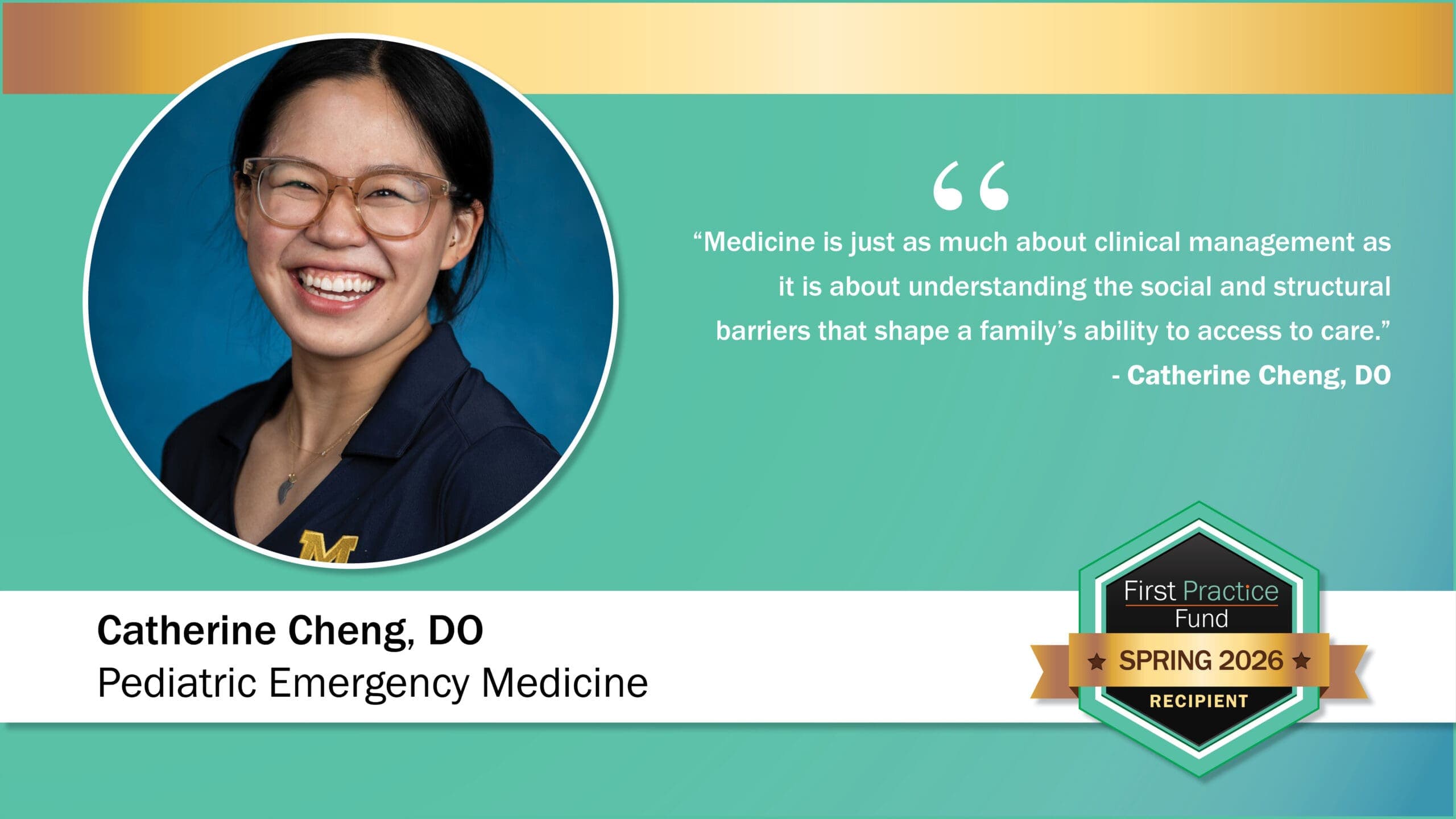
Meet Dr. Catherine Cheng, First Practice Fund recipient
It’s expected to see children rushed to an ER with broken bones and high fevers. What’s less expected is every year, roughly 30 million of those children arrive at U.S. emergency departments with the weight of poverty, housing instability and language barriers. From both sides of the exam table, Catherine Cheng, DO, knows for many of these families, the emergency department is the only door that stays open.
Now completing a fellowship in pediatric emergency medicine, Dr. Cheng is entering one of the most consequential—and underserved—corners of American healthcare. Fewer than 3,500 physicians nationwide identify as pediatric emergency medicine specialists. Those who do are heavily concentrated along the coasts, leaving vast “PEM deserts” across rural and underserved communities where children in crisis have no access to specialized care.
It is precisely because of this landscape—a healthcare system strained by specialist shortages, entrenched inequities and the financial weight borne by its newest physicians—that Dr. Cheng’s pursuit to make an impact where she’s needed most earned her one of nine Spring 2026 First Practice Fund scholarships from PracticeLink.
The $2,500 scholarship awarded to aspiring physicians and advanced practice providers, recognizes trainees whose commitment to community-centered care goes beyond the clinic.
With Scion Health as a primary sponsor and Ballad Health and Navigate as program sponsors, the Spring 2026 First Practice Fund is a competitive scholarship that weighs essay questions and applicant CVs to identify high-caliber medical trainees poised to lead the future of community-based healthcare. Drawing from her own experiences navigating healthcare barriers as a child in a low-income immigrant family, Dr. Cheng has dedicated her career to understanding and addressing social determinants that impact access to care.
PracticeLink: Describe a time you witnessed or experienced a barrier to healthcare access, how it shaped your perspective on medicine and how you envision addressing such barriers in your future career.
Dr. Catherine Cheng: I had a chronic medical condition as a child that required frequent follow-up visits and occasional hospitalizations. This, coupled with growing up in a low-income household with a single parent, shaped my perspective on healthcare early on. Transportation was dictated by the public bus schedule, which sometimes required all day to navigate and other times resulted in us arriving late to appointments. My father worked several jobs to support our family, and missing work for appointments meant the stress of losing the income we depended on. Because my father had limited English proficiency, I often helped him navigate the healthcare system – translating conversations, completing paperwork and explaining medical instructions. These experiences made me aware of how difficult navigating the healthcare system could be for families with limited resources.
That perspective led me to pursue pediatrics training in North Philadelphia, one of the city’s most impoverished areas. There I learned medicine through the lens of advocacy and addressing barriers to care. I remember caring for a boy whose mother tearfully explained that she had left another hospital against medical advice because she had no childcare for her other children and needed to make arrangements before returning.
The hospital filed a child protective services report after they left, and she later lost her job for missing work to bring him back. Encounters like this reinforced that medicine is just as much about clinical management as it is about understanding the social and structural barriers that shape a family’s ability to access to care. When parents say they cannot stay in the hospital, I do not question whether they care for their children but instead try to understand the obstacles they are facing. Through these experiences, I learned to advocate for my patients by familiarizing myself with community resources and communicating carefully with families to give them space to voice their needs.
I am currently completing my fellowship in pediatric emergency medicine. I envision a career that leverages the emergency department’s role as a safety net for under-resourced families by providing accessible care while building stronger connections with the community. I am currently implementing an HIV screening initiative to reach at-risk youth who may face barriers to primary care, and I volunteer with a street medicine group that provides care for individuals experiencing homelessness. In my future career, I hope to continue these efforts while expanding initiatives that address the needs of families such as food insecurity or establishing access to primary care follow-up.
PL: Share an example of meaningful collaboration across a care team. What made it successful and what did you contribute?
DR. CHENG: An example of meaningful collaboration across a care team occurred during one of my shifts in the emergency department when a patient presented after a motor vehicle accident and suffered significant injuries. Nurses, pharmacists and respiratory therapists worked seamlessly together, allowing us to efficiently proceed with intubation and securing the airway. At the same time, we coordinated expedited head imaging which revealed an intracranial hemorrhage. Neurosurgery was consulted and took the patient to the operating room and the patient survived. Throughout all this, social work played an important role in supporting communication with the patient’s family during this stressful and rapidly evolving situation.
The success of this patient’s care was made possible by strong collaboration across the care team. Individually, none of our skills alone would have been enough to save the patient but working together as a team allowed us to achieve a life-saving outcome. Looking back, my contributions were not centered on the medical management of the patient, but the coordination of care and communication between team members. Encounters like this are frequent in the emergency department and they reinforce that fast-paced and unpredictable nature of emergency medicine relies on clear communication and coordinated teamwork.
PL: Describe a professional challenge you faced in training, how you responded and what you learned.
DR. CHENG: A professional challenge I quickly encountered as a pediatric emergency medicine fellow was finding my confidence and voice as a leader in high-acuity situations. I often worried about making the wrong decision and hesitated to speak up out of concern I might overstep or offend other members of the team while giving directions.
I responded to this challenge by seeking guidance from mentors with similar personalities who I saw lead effectively while remaining thoughtful and collaborative. I practiced in simulations and intentionally took every opportunity to lead medical and traumatic resuscitations during my shifts. After these encounters I asked for feedback from nurses, pharmacists, residents and attendings on my communication and leadership. Their perspectives helped reinforce my input as the physician leading the room was both welcomed and necessary, especially when delivered with respect and collaboration. Additionally, I dedicated myself to strengthening my clinical knowledge which helped build my confidence in decision-making.
One particularly meaningful experience occurred when a neonate presented to the emergency department with seizures. As the only physician with specialized pediatrics training at the time, the team looked to me for guidance and I found myself leading the resuscitation. Although initially daunting, my preparation and clinical knowledge prepared me for the moment, and I was able to lead the team effectively.
Through these experiences, I learned confidence is developed through preparation, repetition and growth in moments of discomfort. By remaining respectful of my team, seeking feedback and continually strengthening my clinical knowledge, I have grown into a more confident physician and advocate for my patients.
PL: Share your career goals and explain how First Practice Fund will help you achieve them.
DR. CHENG: My career goal is to work in a pediatric emergency department serving a diverse patient population while continuing to provide safety-net care to children and families with limited access to healthcare resources. I hope to build a career that combines clinical care, advocacy and research focused on health equity and disparities in pediatric emergency medicine. My current research includes examining inequities in CPS (Child Protective Services) referrals and drug testing practices based on patient demographics. I am also researching initiatives to increase HIV screening in the emergency department which often functions as the primary point of care for at-risk adolescents. I hope to continue and expand this work throughout my career.
Additionally, I am passionate about addressing the social needs that affect families’ ability to care for their children. I am interested in developing systems within the emergency department to connect families with essential resources such as diapers, car seats, food assistance and access to primary care follow-up. The emergency department is uniquely positioned to identify and address these unmet needs for vulnerable families. The First Practice Fund would help support these goals by easing the financial burden associated with transitioning into practice, allowing me to focus on building a career centered on service, advocacy and health equity. This support would provide flexibility to continue pursuing meaningful research and community-focused initiatives that improve care for underserved pediatric patients and their families.

