
 Share
Share- Export to PDF
 Listen
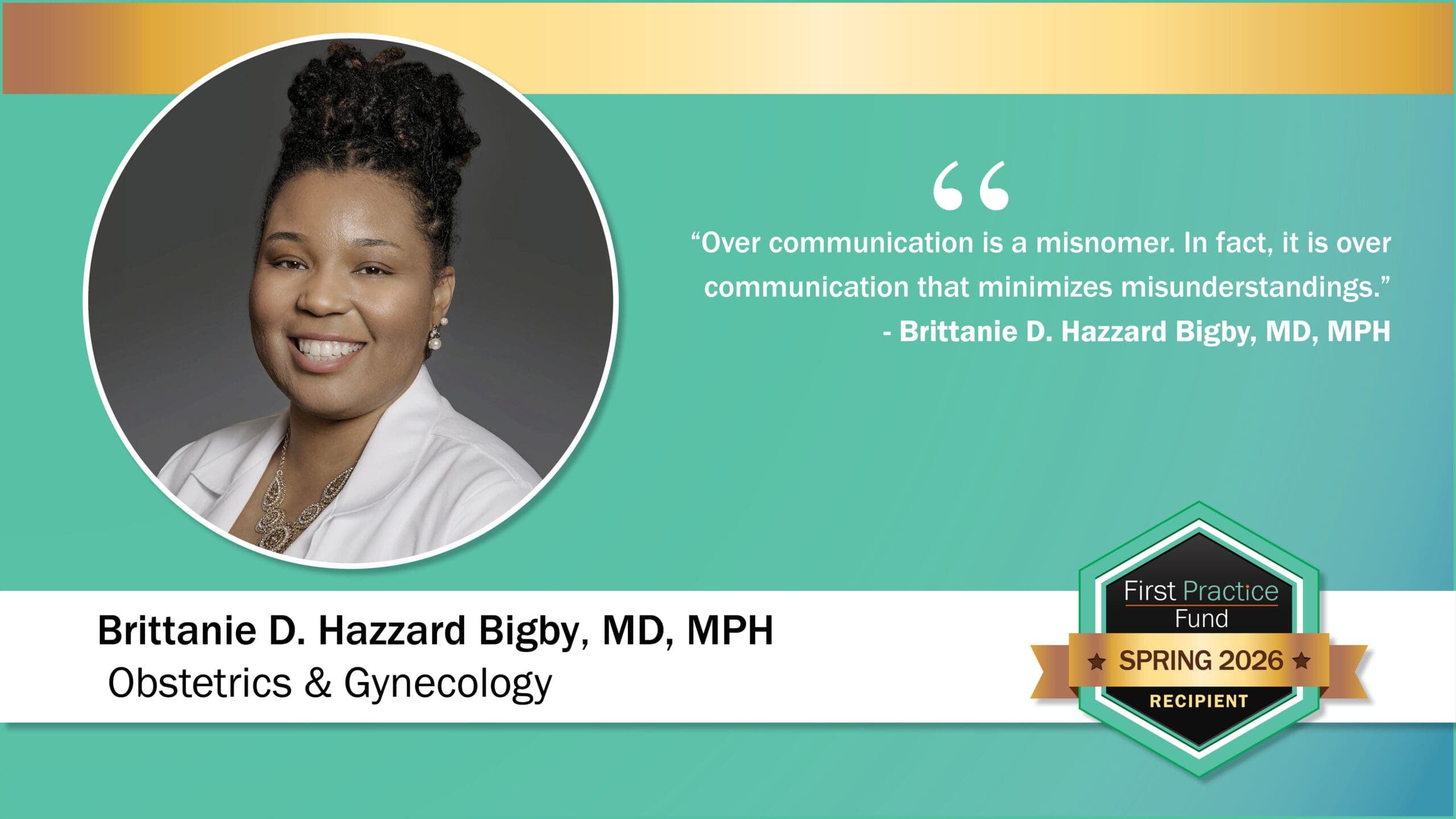
Meet Dr. Brittanie Bigby, First Practice Fund recipient
Nationally, there are only about 38 obstetrics & gynecology specialists per 100,000 women—and far fewer in rural areas. Even where OB‑GYNs are present, insurance network design can limit access, particularly for women of color. For instance, according to KFF, marketplace enrollees in areas with more people of color have access to a smaller share of local OB‑GYNs in network (about 43%) compared with areas with fewer people of color (about 69%).
Meet Brittanie D. Hazzard Bigby, MD, MPH, an OB-GYN resident pursuing a full‑scope OB‑GYN role at a community‑based, safety‑net health center in the South, where many communities face gaps in obstetric services and restrictive reproductive policies.
Dr. Bigby is one of nine recipients of PracticeLink’s Spring 2026 First Practice Fund, a competitive scholarship which awards $2,500 to aspiring physicians and advanced practice providers. She was recognized for her demonstrated exceptional dedication to identifying and addressing barriers to care, ensuring patients receive the support and resources needed to navigate complex healthcare systems.
Sponsored by Scion Health as a primary sponsor and Ballad Health and Navigate as program sponsors, the Spring 2026 First Practice Fund used a combination of essay questions and applicant CVs to identify high-caliber medical trainees poised to lead the future of community-based healthcare. Dr. Bigby’s ability to lead multidisciplinary teams in high-acuity situations, coupled with her vision of providing comprehensive women’s healthcare and health literacy programs in underserved communities, reflects a deep commitment to service, equity and patient-centered care. Her dedication to advancing community health embodies the mission and values of the First Practice Fund.
PracticeLink: Describe a time you witnessed or experienced a barrier to healthcare access, how it shaped your perspective on medicine and how you envision addressing such barriers in your future career.
Dr. Brittanie Bigby: A 38-year-old presented to the emergency department with rectal bleeding. During her evaluation she was incidentally found to be approximately 8 weeks pregnant. Because of other medical concerns she was deemed high risk and followed by maternal fetal medicine. Throughout her prenatal record multiple times it was documented that she was “non-compliant” and “disengaged in her healthcare plans” because she had not had a colonoscopy that was ordered when she first presented with rectal bleeding.
At 28 weeks when asked about why she had not had the colonoscopy, the patient shared that she had called all the places to which she had been referred but each time she presented for the colonoscopy they canceled her appointment because she was pregnant and since they did not have a way to monitor the fetus after the procedure, they were unwilling to provide her services. When the patient delivered at 37 weeks, she was found to have stage IV colon cancer with a poor prognosis.
After that encounter I committed to always asking my patients who have not completed testing or followed through on referrals if there is a barrier I can help them overcome. Most share a myriad of barriers that hinder their ability to fully participate in their treatment plans.
PL: Share an example of meaningful collaboration across a care team. What made it successful and what did you contribute to it?
DR. BIGBY: Called down to the emergency department to assess a 34-week fetus with a placental abruption and a heart rate of 60, normal is 110-160, presented to the obstetric emergency room at 0200. On the stretcher alone, the patient had lost at least 1L of blood. She was alone, did not speak English and the connection to our interpreter was unreliable. As the chief of the service I quickly coordinated her transport to the third-floor labor and delivery operating rooms and alerted the appropriate charge nurse to assemble the operating team. The baby was delivered in less than 20 minutes from the initial presentation to the emergency room despite having to make five incisions on the patient’s uterus because she had unknown fibroids that were the same size as the fetal head.
Based on her blood loss of more than 5L, the patient and her baby were at high risk for a poor outcome. Within two hours of delivery the patient was extubated and the neonate was doing well, without acute interventions in the neonatal ICU. While I was the primary surgeon for the cesarean delivery and responsible for assembling all necessary parties, it was the effortless and constant communication between my team, anesthesia and NICU during delivery of the fetus and repair of the uterus that led to a mom discharged on postpartum day 2, the standard day of discharge and a 34-week neonate in the NICU in observation status to assist with feeding and growing because of their size.
PL: Describe a professional challenge you faced in training, how you responded and what you learned.
DR. BIGBY: Due to resident shortages I was pulled from a rotation to cover a core service. Despite multiple methods of communication to inform my attending, the attending reported me for absenteeism. I was asked to provide an explanation. In my explanation I provided 18 pages of evidence that I was engaged in patient care. After introspection and reflection on the situation I realized that over communication is a misnomer and in fact, it is over communication that minimizes misunderstandings.
PL: Share your career goals and explain how First Practice Fund will help you achieve them.
DR. BIGBY: My goal has always been to practice in a way that blends community education with health care. My post-graduation plans include starting a full scope OBGYN generalist practice at a FQHC (Federally Qualified Health Center) in North Carolina. In addition to providing high quality care, I envision hosting community events including health fairs, single health issue focused educational series and even open forums to help improve the health literacy of the population. The First Practice Fund will help curtail the expenses associated with moving from the northeast to the south as I embark on this journey.

