
 Share
Share- Export to PDF
 Listen
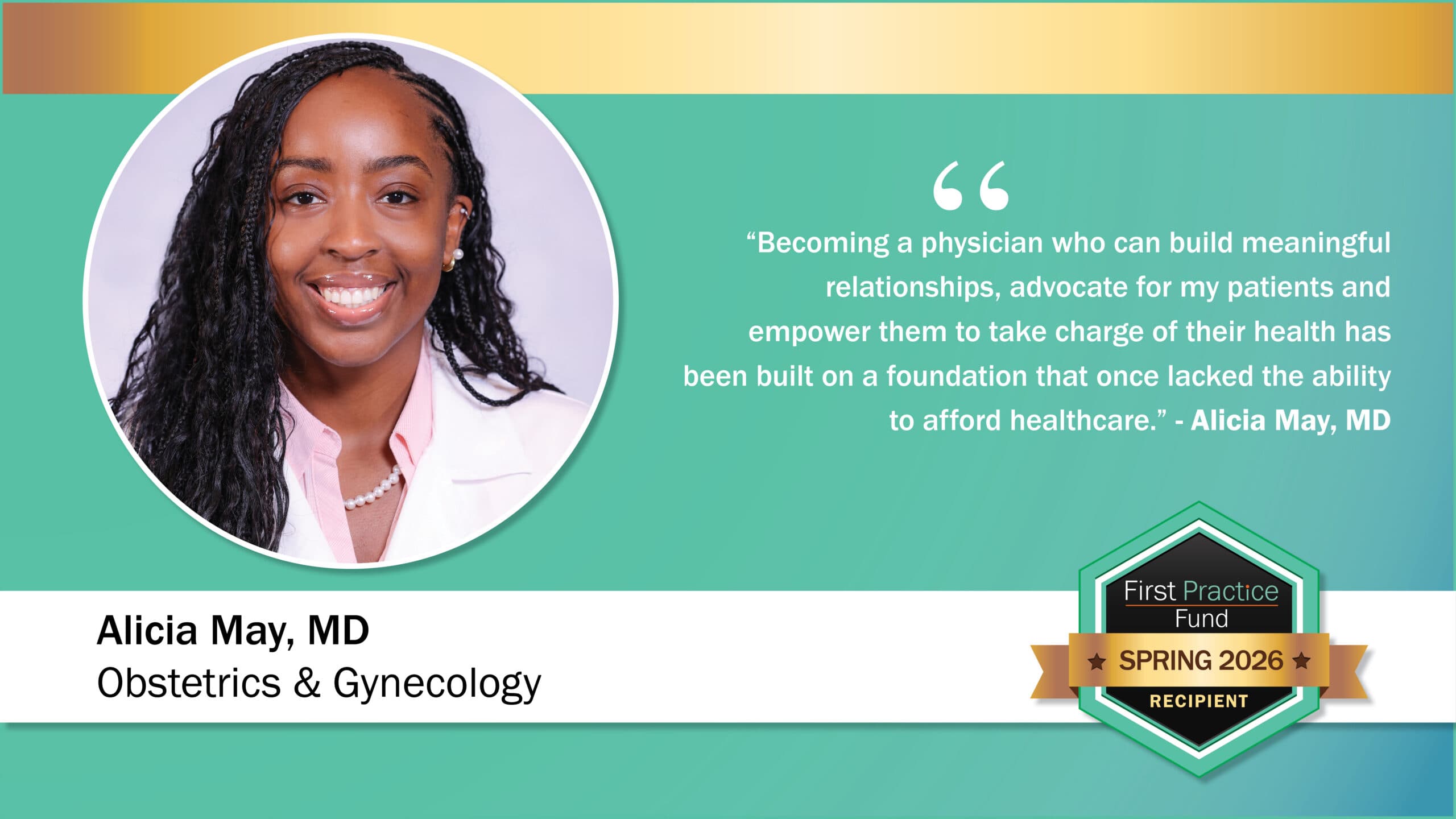
Meet Dr. Alicia May, First Practice Fund recipient
Somewhere in rural America, a pregnant woman is doing the math. Not the math of due dates or baby names, but the harder kind: the cost of gas for a 45-minute drive to the nearest hospital with a labor and delivery unit. The shift she’ll miss. The childcare she can’t afford. Whether the baby can wait.
More than a third of U.S. counties qualify as “maternity care deserts” — places with no or severely limited access to obstetrics care. Nearly half of all counties have no practicing OB-GYN at all. Between 2010 and 2022, more than 500 hospitals closed their obstetric units – over 200 of them in rural communities. Alicia May, MD, grew up inside this system. Raised in the rural South, she watched preventable health conditions take hold around her and came to understand, viscerally, what it means when a community lacks access to basic care.
Dr. May is one of nine recipients of PracticeLink’s Spring 2026 First Practice Fund, a competitive scholarship which awards $2,500 to aspiring physicians and advanced practice providers.
Currently an OB-GYN resident training at the number one trauma center in metro Atlanta, Dr. May was recognized for her dedication to improving healthcare access in rural communities and her commitment to serving patients who face significant socioeconomic barriers to care.
With Scion Health as a primary sponsor and Ballad Health and Navigate as program sponsors, the Spring 2026 First Practice Fund used a combination of essay questions and applicant CVs to identify high-caliber medical trainees poised to lead the future of community-based healthcare. Throughout her training in obstetrics and gynecology, Dr. May has demonstrated resilience, leadership and compassionate patient care while remaining focused on addressing physician shortages and improving maternal health outcomes in underserved areas reflects the mission and values of First Practice Fund.
PracticeLink: Describe a time you witnessed or experienced a barrier to healthcare access, how it shaped your perspective on medicine and how you envision addressing such barriers in your future career.
Dr. Alicia May: “Let your root feed your crown,” was a phrase I learned from artist Bo Bartlett during my third-year ethics course. Letting the foundation be the source of strength and nourishment reinforces my experience as a small-town country girl becoming a first-generation college graduate and now a physician. My journey that started in Toomsboro, GA, instilled in me a work ethic and desire to seek out new opportunities to learn and grow. Early on, I learned the value of hard work and perseverance as I watched my parents make ends meet in a community with limited resources.
I watched as my parents struggled to keep the lights on and feed our family throughout my childhood, and witnessed others live in worse conditions. Because healthcare is not very affordable, we were without insurance. We avoided doctor visits and only went to the hospital that was miles away during extreme circumstances. I have continued to witness disparities that exist and have seen the burden of preventable health conditions and deaths due to health access disparities. Despite the challenges we faced, I remained determined to succeed and break the cycle of poverty that impacted my family and community.
These moments continue to show me what I am doing aligns with my purpose. I know becoming a physician who can build meaningful relationships, advocate for my patients and empower them to take charge of their health has been built on a foundation that once lacked the ability to afford healthcare, but is driven by the change I hope to see. I am excited to see what the future holds for this small-town girl who took initiative and persevered despite many barriers. As I reflect on letting my root feed my crown, I know I have the potential to be a physician confident in the care I provide and confident in my ability to foster resilience in those around me.
PL: Share an example of meaningful collaboration across a care team. What made it successful and what did you contribute?
DR. MAY: Working with midwifery teams has been essential to my learning and the positive outcomes our patients experience. As an intern, I remember going into deliveries with midwives to learn different techniques and to incorporate their practices into my own individualized approach to deliveries. As I have progressed into my training, I have seen this collaboration grow not only in my learning but also in counseling patients. Sometimes patients present to the labor and delivery units but are not well informed about possible risks associated. Our team, along with the midwife team, will go into a patient’s room to make sure she understands her options and our approach to make sure she has a safe delivery. During these counseling sessions, I contribute my knowledge to surgical interventions as well as provide care to the patient after the surgery. This is successful due to joint efforts to make sure our patients are well informed and ready to proceed with delivering their babies in a manner that would prevent harm.
PL: Describe a professional challenge you faced in training, how you responded and what you learned.
DR. MAY: Being a resident has several challenges. One I faced early on balancing a heavy workload with lack of time to complete all the tasks a busy labor unit requires. In metro Atlanta at the number 1 trauma center, I have witnessed several complex situations occurring at the same time with limited team members to handle patient care. Early on I learned how important it is to prioritize and use my team for support. I remember one of my first experiences of seeing a second-trimester loss.
My senior and attending were in a complex C-section while I was on the floor seeing triage and labor patients. A patient in severe pain entered with her partner and was found to have an ultrasound with fetal heart rate present but a dilated cervix. I got assistance from nurses to obtain labs, grabbed an ultrasound and notified my team while I scanned the patient, performed a thorough history and physical exam and spoke with the anesthesia team for management of this patient’s pain.
With this being my first time experiencing a second-trimester loss, I was nervous but I learned that at that moment, I needed to provide support, knowledge and guidance and effective medical care for my patient. Eventually, my team completed the C-section and my attending joined me as I helped clamp the umbilical cord and deliver the remainder of the fetus and placenta. I learned this type of situation can be taxing on providers as well as the entire team.
PL: Share your career goals and explain how First Practice Fund will help you achieve them.
DR. MAY: As a product of so many different areas in rural middle Georgia, I have observed situations that continue to shape my views and approach to tackling rural obstetric healthcare. I strongly feel an essential part of the future of healthcare in rural areas will be geared towards primary prevention and healthcare education.
There are so many barriers to healthcare in rural areas. Rural hospitals are closing and physician shortages are prominent. Healthcare is not affordable for most and insurance out-of-pocket costs are often difficult to pay. Having a full-time job and children makes it difficult for many parents to attend necessary appointments. A high ratio of convenience stores to grocery stores limits access to affordable and nutritious foods.
As a leader of the community, it is important to notice limitations so they can be addressed. I am a strong advocate for healthcare reform that encompasses affordable healthcare, informed healthcare and preventative healthcare. I have a strong desire to use my knowledge and skills to contribute to rural Georgia and address the shortage of physicians in the area. Of all the attributes I have reflected on, I believe my ability to yield meaning from experience is what makes me a top candidate. As a First Practice Fund recipient, I will continue to keep rural Georgia close to my heart and uphold the mission and values of this scholarship.

