
 Share
Share- Export to PDF
 Listen
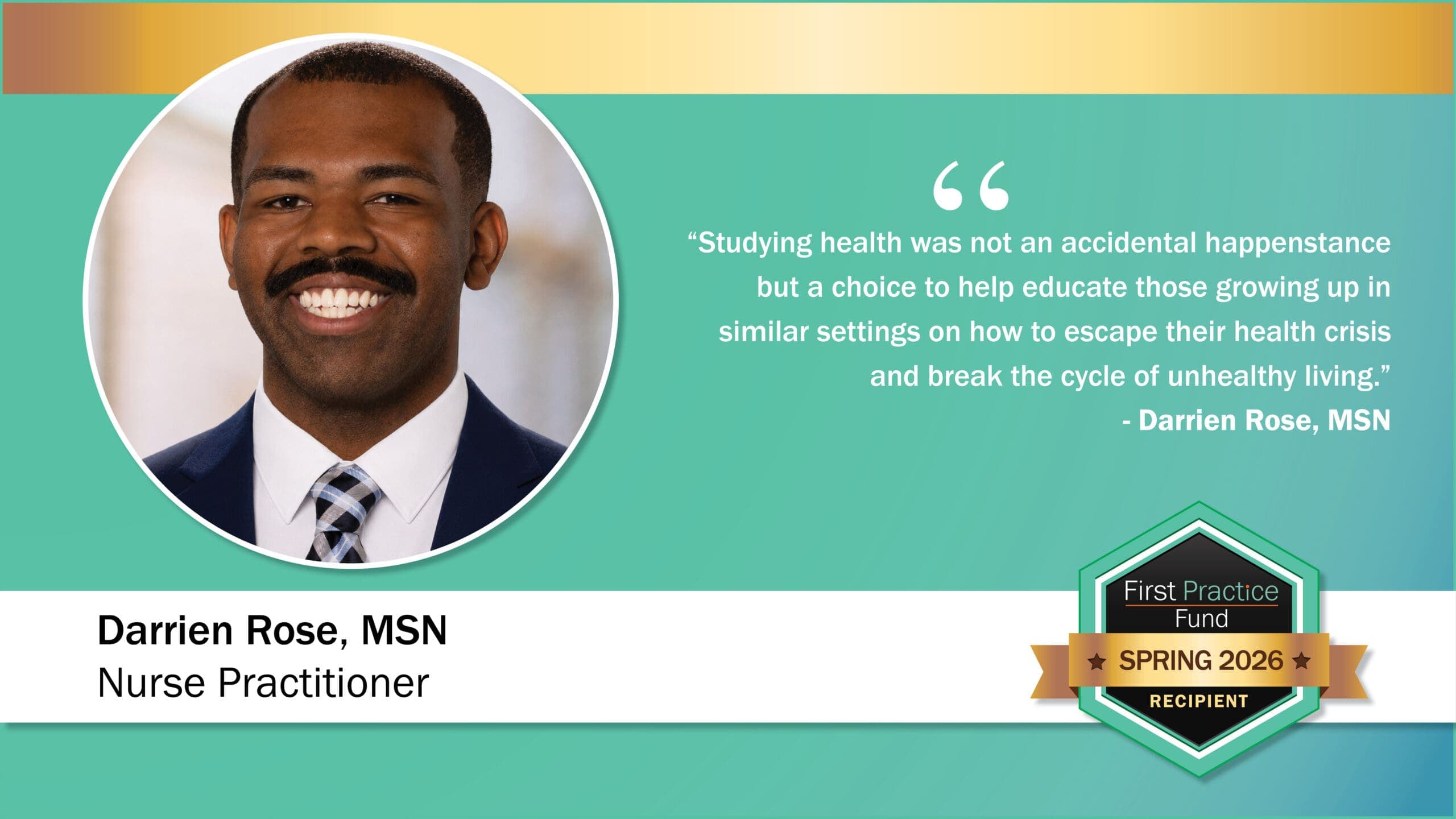
Meet Darrien Rose, First Practice Fund recipient
Where you grow up should not determine your lifespan or how sick you get along the way. Yet for millions of Americans in rural and low-income communities, geography and poverty quietly decide who receives care, who waits and who goes without. Darrien Rose lived that story firsthand. He grew up in a food desert, a community where affordable, nutritious food was rarely available, and he carries the consequences of that experience as a clinician today. As a critical care registered nurse pursuing an advanced practice provider (APP) credential, Darrien is transforming a childhood shaped by structural disadvantage into a career aimed at dismantling it.
Darrien is one of nine recipients of PracticeLink’s Spring 2026 First Practice Fund, a competitive scholarship which awards $2,500 to aspiring physicians and advanced practice providers.
Darrien was recognized for his unwavering commitment to improving healthcare access and health education in rural and underserved communities. Drawing from his own experiences growing up in a community facing significant barriers to healthy living and healthcare access, he has dedicated his career to empowering patients through education, prevention and compassionate care.
Sponsored by Scion Health as a primary sponsor and Ballad Health and Navigate as program sponsors, the Spring 2026 First Practice Fund evaluated essay questions and applicant CVs to identify high-caliber medical trainees poised to lead the future of community-based healthcare. Darrien’s passion for serving underrepresented populations and his vision for expanding healthcare knowledge and access in rural communities embody the mission and values of the First Practice Fund.
PracticeLink: Describe a time you witnessed or experienced a barrier to healthcare access, how it shaped your perspective on medicine and how you envision addressing such barriers in your future career.
Darrien Rose: Growing up in a rural community with limited access to healthcare, I was exposed to healthcare barriers at a young age, with living in a food desert being possibly the greatest predator of them all. As an adolescent I did not have the knowledge or language to describe what I experienced but it impacted me greatly. I was an unhealthy child and to this day as a clinician aware of sustainable health practices, continue to wrestle with habits ingrained throughout my youth.
Studying health was not an accidental happenstance but a choice to help educate those growing up in similar settings on how to escape their health crisis and break the cycle of unhealthy living. In my career thus far, I have been intentional on educating my students, community members and patients on how to best live out healthy lifestyles and utilize food as medicine. In my future I plan to educate my patients and communities on how to prevent chronic illnesses through healthy living and understanding how to utilize resources to live out a life that is sustainable and healthy.
PL: Share an example of meaningful collaboration across a care team. What made it successful and what did you contribute to it?
DR: For me this is a typical day at work as a critical care RN. No one patient is cared for by a sole provider and/or clinician but the entirety of the interdisciplinary team. I will say this is most seen real time in a code blue scenario which is not uncommon in my work. A recent experience that stands out is a code blue not unlike many others in origin but impactful in its fulfillment.
Without too many details, what made this code blue especially successful was the positive patient outcome, the communication and caretaking of each other during and after the event. There was nothing special I did other than hold my space as an active team member for this patient. I believe the best collaboration happens when on a team and you own 100 percent of what you can while supporting those you collaborate with.
PL: Describe a professional challenge you faced in training, how you responded and what you learned.
DR: I began my nursing career as an RN in the COVID-19 ICU. The challenges were abundant but what impacted me the most was patients and their family members denying the existence of the very virus that was causing the demise of them or their loved one(s).
This challenge haunted me because it was founded in misinformation because of a lack of medical knowledge. It was extremely difficult to navigate but I soon found solace in being curious. Listening truly helped me respond my best with truth and love. Through this approach I was not only able to adequately educate others but encourage them to take knowledge back to their communities, allowing them to get the help they needed and do their part in decreasing the spread of the virus. This taught me sometimes your heart can impact more than your brain.
PL: Share your career goals and explain how First Practice Fund will help you achieve them.
DR: My aspirations as an APP is to make access to healthcare more attainable as well as educate rural community members on how to live healthy lifestyles. Throughout my training I have always focused on education and public health. From my first healthcare position as a CNA in a rural community long term care facility to my current role as an ICU RN at an academic facility, my focus has always been on how to close the knowledge gap.
People cannot change what they do not know and will not seek help if they do not know they need it. With the assistance of First Practice Fund, I will be enabled to focus my efforts throughout my academic program on prioritizing clinical sites in diverse rural communities to learn the need and how to best meet it.
I have a heart for underrepresented communities and with the help of this scholarship, the financial burden of traveling to these sites will be lifted.

