Where nurses are in demand and how to turn that demand into career leverage
By Georgia Scott October 7, 2026
 Share
Share- Export to PDF
 Listen
Where nurses are in demand and how to turn that demand into career leverage
If you’re a nurse considering your next career move, one of the most valuable things you can know isn’t just who is hiring or where nurses are in demand. It’s how much they need you.
Demand for registered nurses remains strong nationally. The U.S. Bureau of Labor Statistics projects about 189,100 RN openings each year through 2034, on average, as the profession grows and employers replace nurses who retire, leave the workforce or move into other occupations. The median annual wage for registered nurses was $93,600 in May 2024.
But the national numbers don’t tell the whole story.
Nursing demand differs dramatically depending on where you live — or where you’re willing to go. Those regional differences can create opportunities to increase compensation, gain experience, move into leadership, negotiate better working arrangements or build a career in a community where your skills are especially valuable.
The key is knowing how to turn demand into opportunity.
Where are registered nurses most in demand?
The Health Resources and Services Administration (HRSA) projects a national shortage of approximately 108,960 full-time-equivalent registered nurses by 2038.
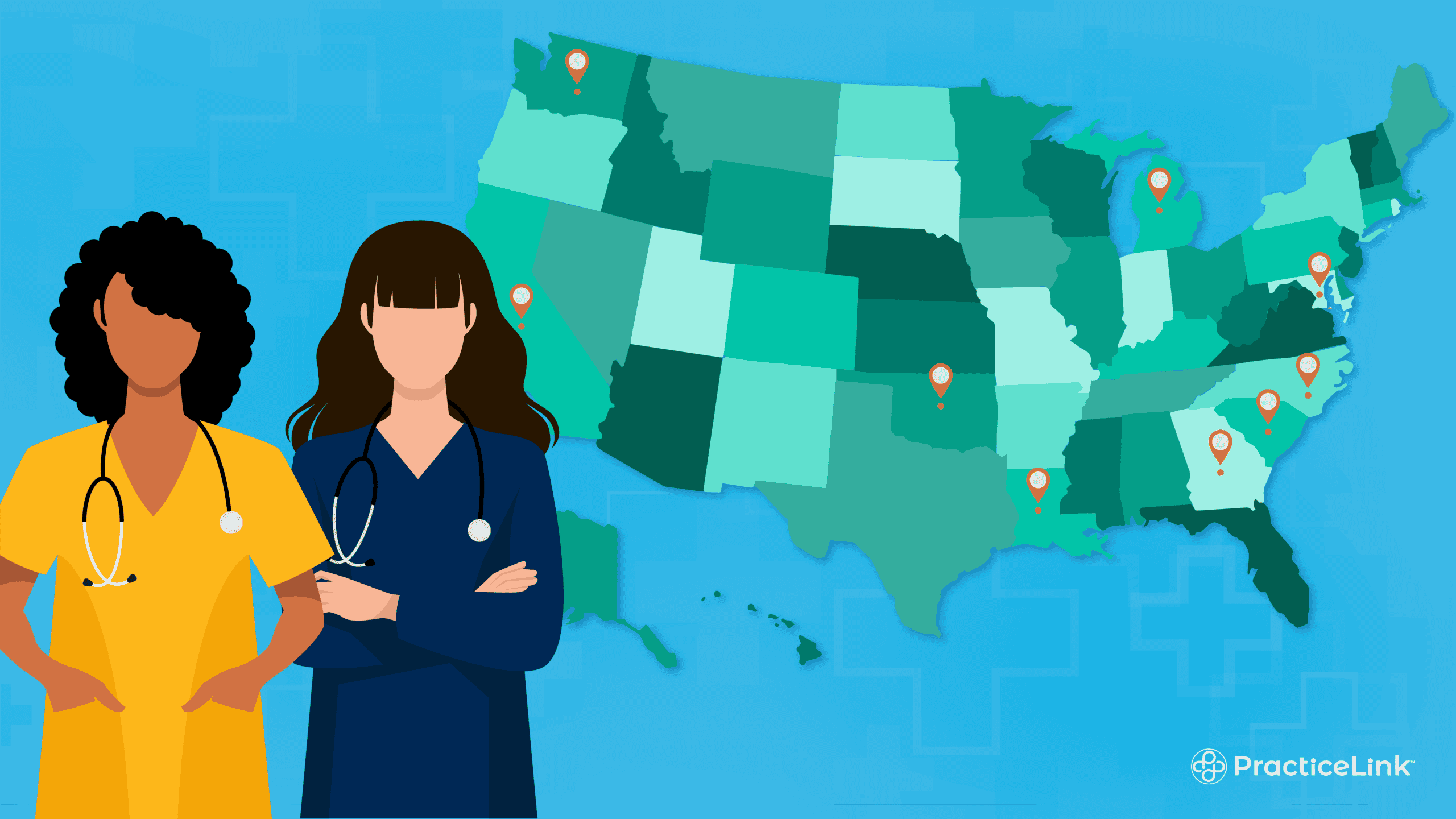
These states have the largest projected RN shortages by percentage in 2038:
- California: 22%
- North Carolina: 20%
- Georgia: 20%
- Michigan: 18%
- Washington: 17%
- Maryland: 16%
- Oklahoma: 13%
- South Carolina: 12%
- Louisiana: 11%
- Virginia: 8%
California’s projected deficit alone represents about 84,750 full-time-equivalent RNs.
That doesn’t mean every hospital in one of these states will be desperate to hire, nor does it guarantee a particular salary. Specialty, experience, facility, location and local labor conditions still matter.
What it does mean is nurses shouldn’t assume their value in the labor market is the same everywhere.
Your ZIP code can change your career options
Nationally, RN supply is projected to reach about 97 percent of demand by 2038. A closer look reveals significant regional differences. Rural and nonmetropolitan communities are a particularly important example. HRSA projects an 11 percent RN shortage in nonmetropolitan areas in 2038, compared with just 2 percent in metropolitan areas.
For a nurse open to relocating, commuting farther or practicing outside a major metro area, that disparity can broaden the conversation with employers.
A rural or hard-to-recruit organization may have reasons to offer incentives that a highly competitive urban employer does not. Depending on the organization, those could include relocation assistance, sign-on or retention incentives, scheduling accommodations, educational support or other benefits.
In this sense, location becomes a vital career strategy.
Nursing demand can give you negotiating leverage
Here’s where workforce data becomes practical. When an employer has difficulty filling a role and your qualifications fit what it needs, you may have more negotiating power than you realize.
That doesn’t always mean telling a recruiter, “I want a higher salary.”
In some organizations, base compensation may be determined by experience-based pay scales, collective bargaining agreements or formal compensation bands. But an employment offer has many components, and some may be more flexible than others.
Before you negotiate, find out what matters most to you.
Depending on the position and employer, areas worth discussing can include base compensation, sign-on or retention bonuses, relocation assistance, shift and weekend differentials, scheduling, PTO, on-call expectations, float requirements, education or certification support, tuition assistance and professional development opportunities.
If an employer can’t move on salary, a better schedule or meaningful education benefit could still make one offer considerably more valuable than another.
The strongest negotiation isn’t simply if they can pay more but which parts of the opportunity are negotiable.
Know why the job is open before you negotiate
Demand can create leverage, but a vacancy also tells a story.
Your job is to find out what that story is.
During an interview, ask why the position is open. Is the hospital expanding? Is a unit adding beds? Did another nurse get promoted? Is the organization launching a new service?
Or is the department having trouble keeping nurses?
Those situations can look identical on a job board and feel completely different once you’re on the unit.
Ask about turnover, orientation and preceptorship. Ask how frequently nurses float to other units. Ask about typical schedules, weekend requirements and overtime. Ask how long current nurses have been on the team.
Your bargaining power matters. So does knowing what you’re bargaining for. A large sign-on bonus isn’t necessarily a great deal if the position itself isn’t sustainable.
Demand can also accelerate career growth
A tight labor market can create opportunities beyond compensation.
When healthcare organizations need experienced nurses, they may also need charge nurses, preceptors, clinical educators, managers and nurses with specialized certifications.
That means your next job search can be about more than finding a similar position at another facility.
Ask prospective employers what advancement looks like.
Can you train in another specialty? Is certification financially supported? Are there clinical ladders? Could you become a preceptor? Is tuition assistance available for nurses pursuing additional education? What pathways exist into leadership?
The nursing education pipeline itself remains constrained. AACN reports that nursing schools were unable to accept tens of thousands of qualified applications in 2025 because of limitations such as faculty, clinical placement sites, preceptors, classroom capacity and budgets. Nurse faculty shortages remain another significant issue.
For experienced nurses, that creates another potential career avenue: your clinical experience may eventually have value not only at the bedside, but in precepting, education, leadership and workforce development.
Compare the whole offer, not just the hourly rate
If you’re fortunate enough to have multiple nursing offers, comparing two hourly rates isn’t enough.
Consider the entire employment picture.
A position with a slightly lower base rate could come out ahead if it offers a shorter commute, better staffing support, stronger shift differentials, more PTO, tuition assistance or a schedule that works better for your life.
Conversely, a larger paycheck may not compensate for an unsustainable call schedule, excessive floating or limited advancement opportunities.
Your goal isn’t necessarily to find the employer willing to offer the largest number.
It’s to find the opportunity with the strongest combination of compensation, support, flexibility, growth and quality of life.
Use nursing demand to make a more strategic career move
The U.S. needs nurses but demand isn’t equal across all regions.
Regional shortages mean two nurses with similar experience could face very different job markets depending on their specialty and location. That’s why understanding workforce demand can be useful before you ever submit an application.
If you’re considering your next move, research your local market. Explore opportunities in neighboring cities and states. Look at rural communities if they fit your lifestyle. Compare organizations rather than accepting the first attractive offer.
When an employer is ready to hire you, remember that the offer is the beginning of a conversation — not necessarily the end of one.
Ask questions. Understand your value. Determine which terms are flexible. Know what you need to succeed, not just on your first day, but several years into the job.
Because in a profession with nearly 189,100 projected openings each year, your next opportunity doesn’t have to be simply another nursing job.
It can be a deliberate move toward the career you want.