 Share
Share- Export to PDF
 Listen
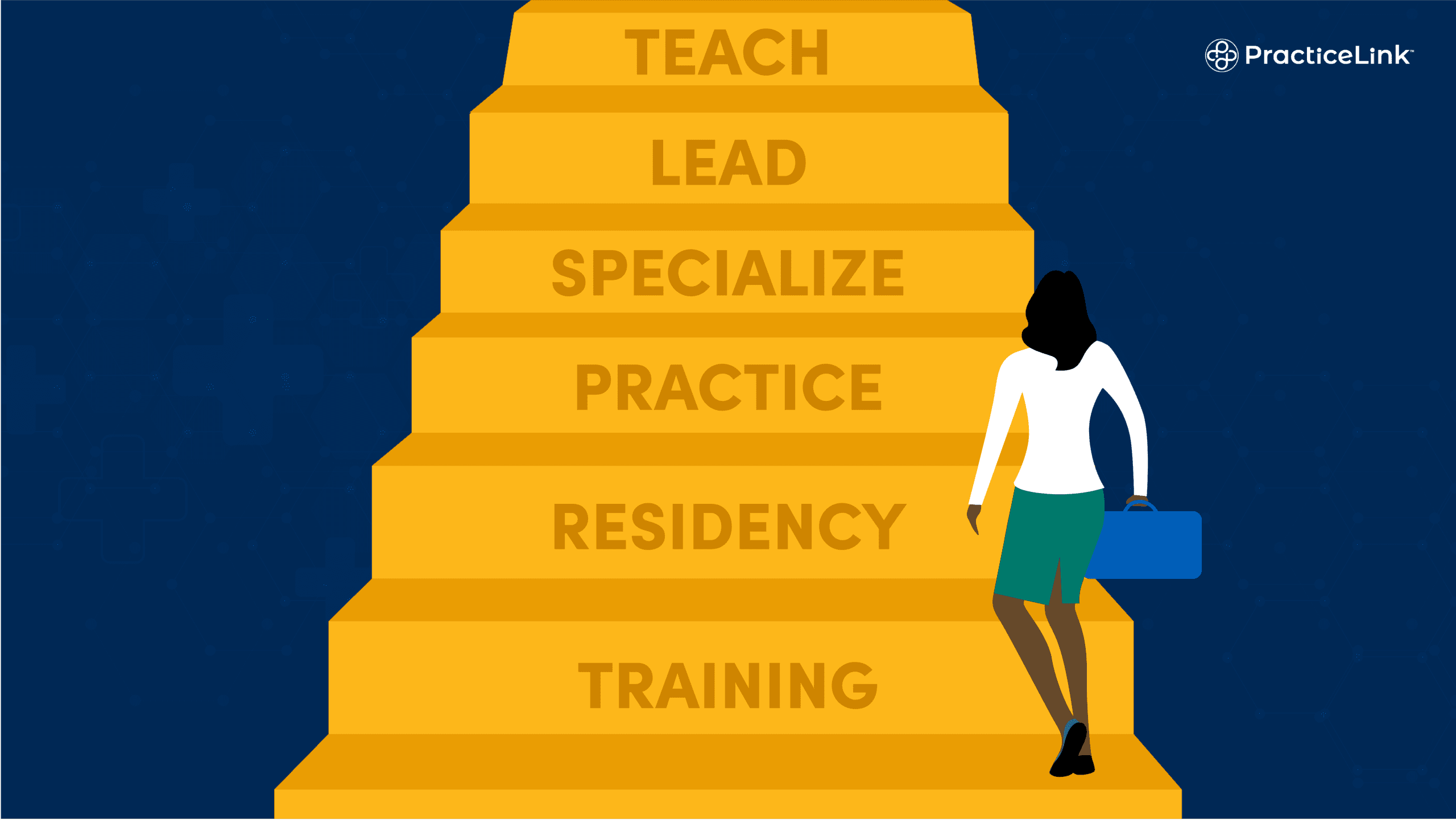
Physician career pathways
The physician career path is a structured yet evolving journey that spans years of education, clinical training and ongoing professional development. From undergraduate studies to residency and beyond, physicians navigate multiple stages that shape both their clinical expertise and long-term career direction.
Whether you are exploring a future in medicine or currently advancing through training, understanding the full trajectory of physician career pathways can help clarify goals and identify opportunities along the way. Resources like a comprehensive physician job search and insights into physician career options can further support informed career decisions.
What is the physician career path?
The physician career path is the sequential progression of education, clinical training and professional growth that leads to—and extends well beyond—independent medical practice. It is not a single fixed route but a framework with defined early stages and flexible later stages that physicians shape according to their interests, values and the needs of the communities they serve.
Education and training
The foundational phase spans undergraduate education, four years of medical school and post-graduate residency training. This phase is largely standardized, though the length varies by specialty.
Clinical practice
After completing training, physicians enter independent practice, where they diagnose, treat and manage patient care in a variety of healthcare settings. These include solo practice, group practice, hospital employment and academic medicine, which may evolve throughout a physician’s working life.
Career advancement opportunities
Over time, physicians may pursue leadership roles, academic positions, sub specialization or non-clinical careers in areas like administration, research or policy.
Education requirements for physicians
Understanding how to become a physician starts with a clear view of the educational requirements.
Undergraduate education
Most aspiring physicians complete a four-year bachelor’s degree, though no specific major is required. Pre-medical coursework typically includes:
- Biology, chemistry, and physics — foundational sciences covered on the MCAT
- Mathematics and statistics — increasingly important for evidence-based medicine
- English and social sciences — preparation for patient communication and the behavioral sciences section of the MCAT
- Research or clinical volunteer experience — strengthens medical school applications
Medical school training
Medical school typically lasts four years and is divided into:
- Preclinical years of classroom-based learning in medical sciences
- Clinical years of rotations across specialties such as internal medicine, surgery, pediatrics and psychiatry
Upon completing medical school, graduates earn an MD or DO degree and are eligible to apply for residency through the National Resident Matching Program (NRMP).
Licensing requirements
Physician licensure in the United States involves:
- USMLE (MD path) or COMLEX (DO path) with multi-step licensing examinations completed during and after medical school
- State medical license for each state where a physician intends to practice
- DEA registration to legally prescribe controlled substances
- Board certification by physician specialty boards; while not required to practice medicine, this is standard and often expected by employers and mandatory for hospital privileges
Residency training
Physician residency training is a critical stage where medical graduates gain specialized, hands-on experience.
Purpose of residency training
Residency prepares physicians to manage patients across the full spectrum of a specialty’s conditions—independently, safely and competently. Residents work under attending supervision while progressively assuming more responsibility. The goals include:
- Developing clinical decision-making and diagnostic reasoning
- Mastering specialty-specific procedures and protocols
- Building communication skills with patients, families and interdisciplinary teams
- Meeting the requirements for specialty board certification
Residency program structure
Residency programs are accredited by the Accreditation Council for Graduate Medical Education (ACGME) and range from three to seven or more years. Key features include:
- Rotations Exposure to core areas within a specialty
- Call schedules Structured on-call requirements with federal duty-hour regulations in place
- Graduated responsibility Progressive autonomy as competency develops
- Evaluations Regular milestones and competency assessments against ACGME standards
Career decisions during residency
Residency is also a time when physicians:
- Refine their specialty interests
- Consider sub specialization
- Prepare for their first physician job
Fellowship and specialization
After residency, some physicians pursue fellowship training to develop expertise in a subspecialty. Understanding physician specialization options can help physicians chart a more targeted career trajectory.
Reasons physicians pursue fellowships
- Develop expertise in a subspecialty
- Increase career opportunities
- Engage in research or academic medicine
Examples of subspecialty fields
Fellowship training exists across virtually every specialty. Common examples include:
- Cardiology (after internal medicine residency)
- Pediatric Surgery (after general surgery residency)
- Interventional Radiology (after diagnostic radiology residency)
- Reproductive Endocrinology (after OB-GYN residency)
- Neurological Surgery subspecialties such as spine or pediatric neurosurgery
Career advantages of specialization
Specialization can lead to:
- Increased demand in certain fields
- Opportunities in academic and research settings
- Advanced procedural or diagnostic expertise
Early career physician development
The years immediately following training are among the most formative in the physician career progression. Decisions made early can shape compensation, lifestyle and long-term satisfaction.
Choosing a practice setting
Early-career physicians evaluate a variety of employment models:
- Hospital employment has a predictable salary, benefits and administrative support; most common model for new graduates
- Private practice provides greater autonomy and potential earning, but more administrative responsibility
- Multispecialty or single-specialty group has shared overhead and call coverage with peers
- Academic medicine is a combination of clinical practice, teaching and research
- Federally Qualified Health Centers (FQHCs) or Veterans Affairs have underserved community focus, often with loan repayment incentives
Building clinical experience
Early-career physicians focus on:
- Refining diagnostic and treatment skills
- Managing patient loads independently
- Developing efficiency and confidence
Professional networking
Networking plays a role in career growth through:
- Mentorship relationships
- Professional associations
- Conferences and continuing education
Resources on how to find physician jobs can help guide this transition.
Mid-career physician opportunities
As physicians gain experience, physician career development often expands beyond clinical practice.
In fact, industry reports on physician compensation point out hospitals and health systems increasingly tie bonuses to leadership responsibilities, quality metrics and committee work, indicating physicians are commonly taking on formal administrative duties alongside patient care.
Leadership roles
Experienced physicians are often recruited into clinical and organizational leadership, including:
- Department chair or chief of staff — overseeing clinical operations within a service line
- Medical director — leading quality improvement, credentialing and utilization programs
- Physician champion roles — driving technology adoption, safety initiatives or population health programs
Academic medicine
Physicians at academic medical centers may expand their roles to include:
- Teaching and supervising residents, students and fellows
- Conducting or participating in clinical research and grant-funded investigations
- Developing continuing medical education (CME) programming
Some physicians pursue formal administrative training, including an MBA, MHA or MMM (Master of Medical Management). Administrative roles allow physicians to:
Healthcare administration
- Influence healthcare systems
- Improve patient care delivery
- Participate in policy and operational decisions
Late- career physician paths
Later aspects of the physician career stages often involve transitioning roles and redefining professional goals.
Mentorship and teaching
Experienced physicians frequently:
- Mentor younger physicians and residents
- Teach in academic or clinical settings
- Share knowledge through speaking or writing
Part-time practice
Some physicians choose to:
- Reduce clinical hours
- Shift to flexible or locum tenens work
- Focus on specific areas of interest
Transition planning
Late-career transition planning may include:
- Retirement preparation
- Financial planning
- Succession planning
- Exploring non-clinical roles
How workforce trends affect physician career paths
External factors significantly shape the physician career path, including evolving healthcare needs and workforce dynamics.
Physician shortages
Growing demand for healthcare services has led to shortages in many specialties and geographic areas.
- The AAMC’s March 2024 report projects a national shortfall of up to 86,000 physicians by 2036, with 17,800–48,000 of those in primary care and 21,000–77,100 in non-primary care specialties
- HRSA’s 2024 National Center for Health Workforce Analysis forecasts a shortage of 87,150 primary care physicians by 2037
- 31 out of 35 physician specialties are projected to face shortages by 2037, according to HRSA’s November 2024 workforce projections
- Rural communities face disproportionate impacts: HRSA projects nonmetro areas will experience up to a 58% physician shortage by 2038, versus 5% in metro areas
- Physician burnout compounds the shortage: a 2024 Physicians Foundation survey found that 6 in 10 physicians and residents reported experiencing burnout often
Healthcare technology
Advancements in technology are reshaping day-to-day clinical work across specialties.
- Artificial intelligence and machine learning: Clinical decision support, imaging analysis and predictive analytics
- Telehealth: Expanding access to care and creating new physician practice modalities
- Electronic health records (EHRs): Ongoing evolution toward interoperability and reduced administrative burden
- Remote monitoring and wearables: Enabling longitudinal patient management outside traditional clinical settings
Team-based care models
Modern healthcare increasingly emphasizes:
- Collaboration with nurse practitioners and physician assistants
- Interdisciplinary care teams
- Integrated healthcare systems
Insights into physician workforce trends can help physicians anticipate future opportunities.
How physicians can plan their career path
Intentional physician career planning can help physicians align their professional decisions with their personal goals, values and the communities they hope to serve.
Evaluating career goals
Physicians benefit from periodically reassessing what they want from their careers. Useful questions include:
- What patient population do I most want to serve?
- How important are compensation, work-life balance, geographic flexibility or academic engagement?
- Do I want to lead, teach, conduct research or focus exclusively on clinical care?
- Am I open to non-clinical career directions if the opportunity arises?
Exploring specialty demand
Understanding demand trends can guide:
- Specialty selection
- Practice location decisions
Using physician career resources
A variety of resources support physician career planning.
- Best physician job boards: Specialty-specific and broad-based platforms that aggregate opportunities from hospitals, health systems and practice groups
- Specialty society career centers: Many professional organizations host job listings and career development tools for members
- Professional mentors and advisors: Experienced colleagues who have navigated similar career decisions
- Medical staffing and placement firms: Recruiters who specialize in physician career transitions and job matching
How PracticeLink supports physician career development
PracticeLink is designed to connect physicians with physician job opportunities at every stage of the career path—whether you are a graduating resident looking for your first attending position, a mid-career physician exploring a new specialty or geography or a late-career physician seeking a part-time or locum arrangement.
Through PracticeLink, physicians and advanced practice providers can:
- Search jobs by specialty and filter opportunities across primary care, surgical, medical and other specialty categories
- Explore geographic opportunities and find positions in regions with high demand or preferred locations
- Connect with healthcare employers and engage directly with hospitals, health systems and practice groups actively recruiting physicians
- Access career resources and tap into tools and insights that support informed physician career decisions
Whether you are entering practice or exploring new opportunities, PracticeLink supports your ongoing professional journey.
Frequently Asked Questions
What is the typical physician career path?
The physician career path typically includes undergraduate education, medical school, residency training and independent clinical practice.
How long does it take to become a physician?
Becoming a physician generally takes 11 to 15 years depending on specialty and training requirements.
What happens after residency training?
After residency, physicians may enter clinical practice, pursue fellowship training or explore other healthcare career opportunities.
Can physicians change career paths?
Some physicians transition into different specialties, leadership roles, research positions or non-clinical careers during their professional journey.
The physician career path is both structured and flexible, offering a wide range of opportunities for growth, specialization and professional development. While the journey requires significant commitment, it also provides diverse ways to shape a meaningful and evolving career in healthcare.
From early education to late-career transitions, understanding each stage can help physicians make informed decisions and align their work with their long-term goals.