
 Share
Share- Export to PDF
 Listen
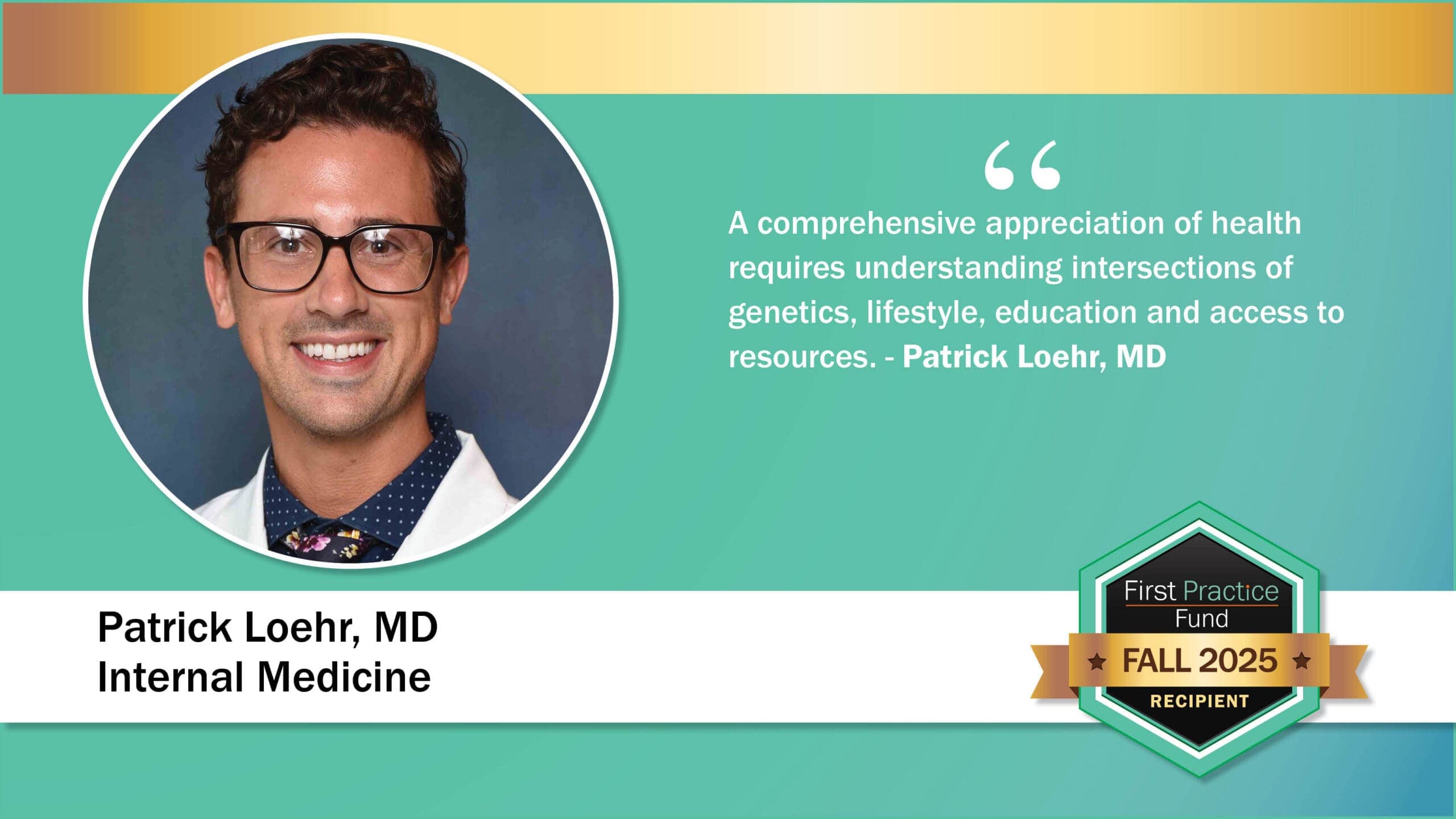
Meet Patrick Loehr, First Practice Fund recipient
Beyond clinical expertise, medicine demands individuals to carry intellectual rigor and deep human empathy into every patient encounter. The best physicians don’t just diagnose and treat; they listen, advocate and see the full person behind the chart. They push through exhaustion, navigate complexity with humility and never lose sight of why they chose their path. Dr. Patrick Loehr is precisely that kind of physician.
Dr. Loehr is one of nine recipients of PracticeLink’s Fall 2025 First Practice Fund, a competitive scholarship which awards $2,500 to aspiring physicians and advanced practice providers. Applications are now being accepted for Spring 2026.
Sponsored by Premier Health, winning criteria for the Fall 2025 First Practice Fund selected recipients based on essay answers and applicant CVs, seeking high-caliber medical trainees poised to lead the future of community-based healthcare. In his entry, Dr. Loehr displayed admirable character across every role he inhabited. He is a clinician who treats patients through the lens of their social realities, a collaborator who strives to lead with humility and clear communication and a lifelong educator who mentors younger healthcare professionals.
PracticeLink: Describe a time you witnessed or experienced a barrier to healthcare access, how it shaped your perspective on medicine and how you envision addressing such barriers in your future career.
Dr. Patrick Loehr: Prior to medical school, while enrolled in a career-change, post-baccalaureate premedical program, I began volunteering at a student-run free clinic in San Diego that serves a large population of uninsured Spanish-speaking patients. It was there I learned the extent to which health is sculpted and determined by social context and witnessed the impact of financial disparities on chronic disease prevention and management.
Nearly all patients I encountered suffered a burden of comorbidities including high blood pressure and cholesterol, diabetes, chronic lung disease and heart failure. I learned a comprehensive appreciation of health requires understanding intersections of genetics, lifestyle, education and access to resources. It was at this time I also encountered the book, “Listening for What Matters: Avoiding Contextual Errors in Health Care” by Saul Weiner and Alan Schwartz. Considered well-received in the healthcare community, it addresses the problem of medical errors that occur when clinicians disregard the context of an individual patient’s life. I developed and have since maintained a commitment to practicing medicine in a way that is informed by one’s culture, preferences, opinions, values and limitations.
After gaining admission to the University of California, San Diego School of Medicine, I was accepted into UCSD’s Program in Medical Education for Health Equity (PRIME). Through PRIME, I took elective coursework in social determinants of health and barriers to equity, developed a health curriculum for a local under-resourced high school, performed various projects with underserved communities (including immigrants, refugees and indigenous peoples) and completed a master’s degree. In my current role as a resident in internal medicine, I am part of UCSD’s Global Health pathway, through which I will rotate in Tijuana, Mexico and Maputo, Mozambique to provide care to underserved communities and hone a more informed perspective on the factors that preclude or compromise their access to high-quality, equitable care.
Moving forward, I plan to use insights gained from these experiences to address and combat barriers to health. By familiarizing myself with factors that have the biggest impact on a patient’s physical, mental and emotional well-being, and by knowing when and how to enlist the help of additional resources, I aim to offer realistic, attainable and meaningful therapeutic interventions for all of my patients.
PL: Share an example of meaningful collaboration across a care team. What made it successful and what did you contribute to it?
Dr. Loehr: My most meaningful collaborative experience in clinical care was as a new senior resident in the critical care unit. The service is perpetually busy and rotation required long hours across interspersed day and night shifts. I oversaw admission of a patient for altered mentation and psychomotor agitation. I could never have predicted his case would become as complex as it did.
The patient was an organ transplant recipient (history of alcohol-related cirrhosis) and on immunosuppressive medication. Prior to admission he was intubated at an outside hospital when escalating doses of medication were unable to abate his agitation. Upon arrival to our critical care unit, a broad workup was initiated that included lumbar puncture, infectious serologies, plasma exchange, serial CT and MR scans, EEG and echocardiography. An acting intern on the team was assigned to follow this patient. Multiple specialties were consulted, including neurology, toxicology, hepatology, infectious disease, psychiatry and nephrology.
My role as the senior resident was to facilitate smooth, concordant collaboration between each of the consultants and their recommendations. Each morning, I would help the acting intern interpret new data and brainstorm an updated plan accordingly. We would also set aside time each afternoon to update the patient’s family on the latest lab values, imaging findings or treatment sequelae. At the time, I found myself impressed by the degree of organization and seamlessness of the synthesized care plan, but when I reflect on the experience now, it’s all the more impressive and meaningful.
To me, the success of this patient’s hospital course wasn’t that it was rooted in flawless diagnostic know-how—in fact, while the patient was ultimately extubated successfully and discharged home, the etiology of his presenting symptomatology was never determined with unequivocal certainty—but rather that many attendings, fellows, residents, nurses and students across multiple specialties worked tirelessly to navigate a complex case with no obvious answer. Yet everybody was equally committed to a goal of providing empathic, evidence-based care. This was a remarkable example of how a clinical care team—with humble leadership, shared vision and clear and respectful communication—can be much greater than the sum of its parts.
PL: Describe a professional challenge you faced in training, how you responded and what you learned.
Dr. Loehr: As an intern on an inpatient service, I encountered a patient at the end of a brief hospital course. She initially presented to the emergency department after choking on food. She was seen by the gastroenterology service and consented to endoscopy. Because her upper GI tract had unusual anatomy, it was determined she needed to be intubated before proceeding with endoscopy.
A day later, at which point she had been successfully extubated, she shared with me and my attending, with tears streaming down her face and a palpable air of panic and unease, she was conscious for the beginning of the procedure. The medication administration record confirmed paralytics were given just over twenty minutes prior to sedatives. My attending apologized profusely and I did the same. While neither of us was responsible nor present for what transpired in the emergency department the day prior, the patient deserved a genuine apology for obvious trauma suffered.
My attending instructed me to print a copy of the procedure report and give it to the patient with the rest of her discharge papers. A nurse witnessed this and reported me for improper conduct. My attending didn’t know patients should solicit such reports through the medical records office and I, just as unaware and uninformed, was following instructions given by my superior.
Ultimately everything was resolved after I met with program leaders, recounted my involvement in the situation and shared my thoughts on how to prevent similar misunderstandings in the future. For me, there were two essential pearls to be gleaned from this experience: one, effective communication in clinical care should be clear, goal-oriented and respectful; and two, impression management is complex and unpredictable.
Communication is an essential, pervasive and highly nuanced skill in health care, so much so that interpersonal and communication skills are one of the six competency domains that comprise evaluation of all resident physicians in the US. Humans are fallible; mistakes, including in medical decision making, are inevitable. What matters is how mistakes are communicated to patients and among members of a care team. Assuming nefarious intent serves to discredit individual and collective value systems and increases the risk of burnout among clinicians. Because I recall how it felt to be on the receiving end of such assumption, I am committed to an ongoing effort to utilize and model clear, respectful and non-judgmental communication practices I believe make medicine a more impactful and rewarding career.
PL: Share your career goals and explain how First Practice Fund will help you achieve them.
Dr. Loehr: In college I majored in literature and art history; I didn’t study science and wasn’t pre-med. Following graduation, I worked as a high-school teacher for ten years, first in Europe (Spain and France) and subsequently in New York City and San Diego. I loved everything in my teaching career, from curriculum and assessment design to the opportunity to enrich the psychosocial and emotional development of my students. When I made the decision to pivot careers and apply to medical school, it was done with the understanding I would remain a lifelong educator. At UCSD School of Medicine, I continued to nurture my teaching and mentorship skills in various ways, including as the student representative to the Committee on Educational Policy, a TA for the LGBTQ+ health elective, the president of an outreach group for teens interested in a career in STEM and the student council director of academics. When I was admitted to PRIME, I was all too excited to apply to become the first medical student to pursue a master’s in the program.

