
 Share
Share- Export to PDF
 Listen
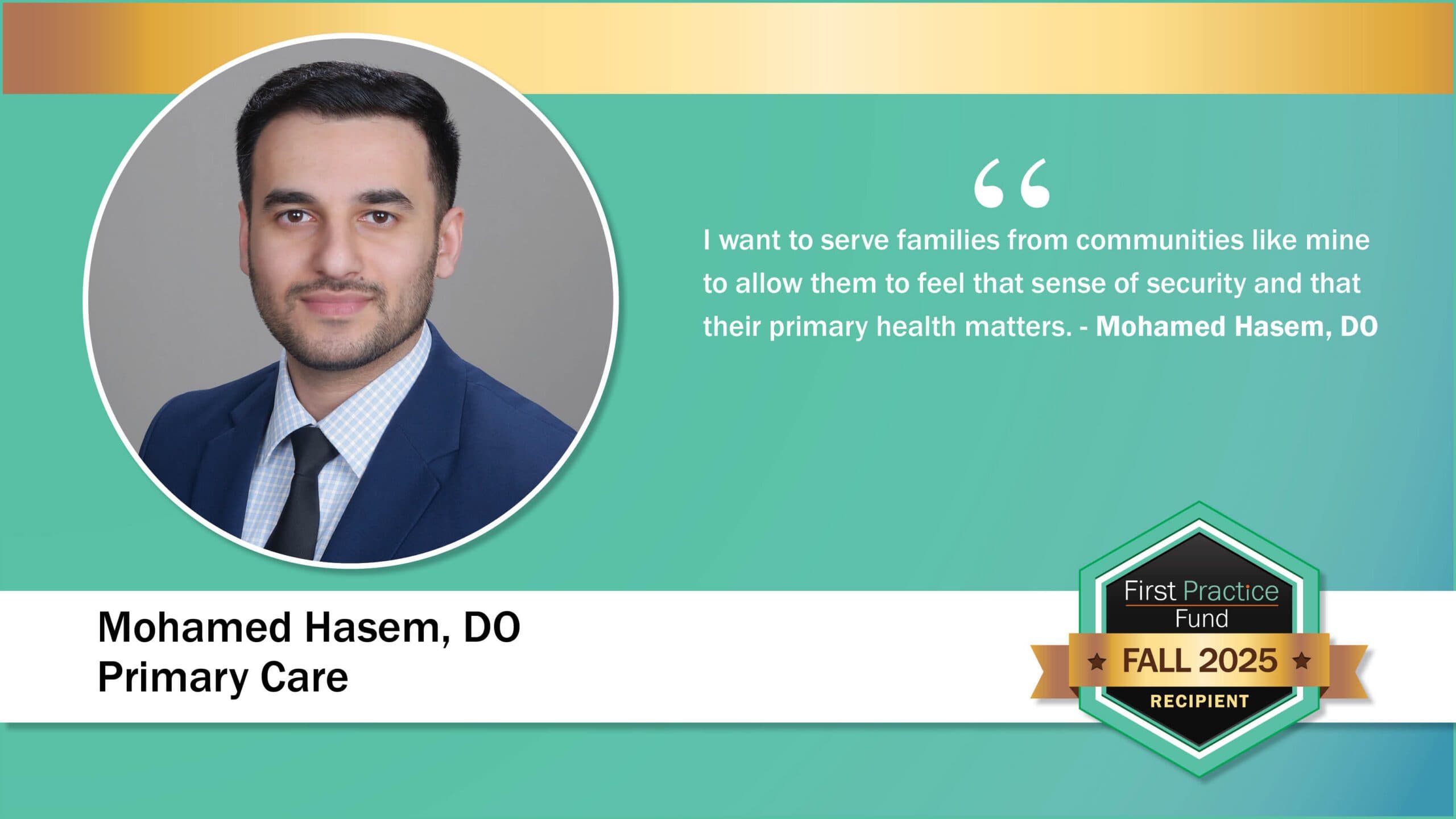
Meet Dr. Mohamed Hashem, First Practice Fund recipient
If “all great changes are preceded by chaos,” as Deepak Chopra famously observed, it’s no wonder Dr. Mohamed Hashem’s early life challenges—in the form of airstrikes, displacement, a father captured at the border and immigrating as a refugee to the U.S.—put him on a path of service. Dr. Hashem, one of nine recipients of PracticeLink’s Fall 2025 First Practice Fund, emerged as a physician whose life mission was forged not in a classroom but in a refugee family’s first visit to a community health center.
First Practice Fund is a competitive scholarship which awards $2,500 to aspiring physicians and advanced practice providers. Applications are now being accepted for Spring 2026. Dr. Hashem was recognized for his mission to bridge gaps in access, integrate social support into medical care and improve public health outcomes for underserved populations.
Sponsored by Premier Health, the Fall 2025 First Practice Fund used a combination of essay questions and applicant CVs to identify high-caliber medical trainees poised to lead the future of healthcare. Dr. Hashem’s lived experience, collaborative mindset, commitment to health equity and dedication to community-based medicine are proof that profound callings are often born in the most desperate circumstances.
PracticeLink: Describe a time you witnessed or experienced a barrier to healthcare access, how it shaped your perspective on medicine and how you envision addressing such barriers in your future career.
Dr. Mohamed Hashem: My earliest childhood memories consist of strangers coming to my family home, asking for help. My dad was a physician in Iraq, a country debilitated by war during the Saddam Hussein dictatorship. As one of the only physicians in our town during such a tumultuous time, strangers would often come to him not only with health concerns but also their life struggles. He often started as their physician but quickly became their friend.
Despite the small community we were building, life in Iraq became unlivable. Airstrikes, poverty and religious persecution grew widespread. My father’s role as the community physician made him a target. My family escaped to Jordan, but he was captured soon after and set to be deported back to Iraq for execution. Fortunately, my family was granted asylum by the United States. I remember the long flight to our new home, looking out the airplane window at the Arizona terrain—with its vast expanses of sandstone mesas and canyons—that looked eerily like the home I had just left.
The transition to the U.S. was difficult. I was a seven-year-old refugee who couldn’t speak the language and was fearful of what was to come. My fear quickly dissipated after my family’s first visit to a community health center. It was our first time receiving medical care in ten years. My siblings and I received a check up and were caught up on vaccinations we had missed throughout the years. My parents had their blood pressure checked for the first time, where they found my father had high blood pressure.
During my visits with him to the clinic, I noticed the various resources available. There was a social worker and insurance specialist that helped my family obtain Medicaid. There was a legal department that ensured our paperwork was in order so we could apply for assistance. A nutritionist met with my father and reviewed dietary and lifestyle modifications he could make to control his blood pressure. Being cared for by this entire team filled me with joy and relief.
The community health center supported us not only in our health but in all aspects of our lives. This ignited a lifelong path of service and ultimately led me to medicine and health. I want to serve families from communities like mine to allow them to feel that sense of security and that their primary health matters. Ultimately, my goal is to use my degree to improve the public health of underserved communities and address the barriers they face.
While studying, I use my extra time volunteering in underserved communities in different ways until I am fully trained as a provider. Providing mentorship, tutoring and resource education have all been rewarding experiences. I was eager to spend time in the clinic to listen and connect with these individuals. When I participated in the National Medical Fellowship Primary Care Leadership Program (NMF PCLP), I received hands-on experience with patients who suffered as a result of various healthcare disparities. I witnessed firsthand the different types of barriers that these patients had to overcome to seek basic treatment. This program sparked my interest in public health. I realized that to make an impact in public health I must go beyond my duty of seeing patients in the clinic and research the barriers that different populations of patients face to bridge the gap between them and I. I’ve learned that to best support underserved communities, one needs to understand them first. As a future physician, I plan to practice medicine in underserved communities, such as the one I worked with in Boston through NMF PCLP.
I hope to address barriers by practicing in community-centered settings that integrate medical care with social support, just as the clinic did for my family. I plan to advocate for models of care that include language services, legal assistance and insurance navigation so patients are not limited by the same challenges we faced as refugees. Through my training in public health, I aim to identify structural gaps that prevent families from accessing timely and equitable care and work with multidisciplinary teams to design programs that bridge those gaps. Ultimately, my goal is to ensure underserved patients receive not only treatment, but stability, dignity and support necessary to maintain their health long-term.
PL: Share an example of meaningful collaboration across a care team. What made it successful and what did you contribute to it?
DR. HASHEM: One of the most meaningful collaborations I experienced occurred while caring for an uninsured, middle-aged man admitted with complications of uncontrolled diabetes. He often jumped between providers and did not consistently follow up with one provider. He presented to the hospital with leg swelling and was found to have cellulitis. On further questioning, he admitted that because of lack of insurance he did not go to the doctor consistently and often rationed insulin and other medications or reused syringes due to cost. This likely led to his cellulitis and uncontrolled diabetes and ultimately hospitalization. His underlying issue was not glucose control, but access to healthcare.
Recognizing his barriers to care would cause re-admission and worsening of and complication of chronic disease, it was important for us to work as a team to address these. I coordinated between multiple specialists such as pharmacy, social work, nutrition services and schedulers. I worked with the pharmacy to see which of the patient’s medications could be subsidized to help with affordable payment. I worked with social work to begin the insurance application process for the patient. I consulted a nutritionist to teach the patient more about his diabetes and the role food plays in this. I worked with schedulers to set the patient up with multiple visits with a primary care physician. Some of which were virtual to ensure the patient could see a provider even if he was unable to go in person. Nursing worked with the patient to reinforce medication education before discharge. In addition to coordinating between team members, my role was to synthesize recommendations into a unified, patient-centered care plan and ensure the patient fully understood every step. I sat with him and walked through the plan, explaining where to pick up medications, who to call for refills and when to return for follow up—details that are often overwhelming for patients navigating the system alone.
This effort was successful due to every member understanding their role and taking an initiative in performing them. It was also successful because there was one member who organized all components of care and ensured everyone was performing their tasks.
That experience exemplifies how every team member has a role, and these are all valuable in ensuring the best outcomes for the patient. The best outcomes for patients happen when medical teams work in a collaborative effort. True collaboration is what transforms good care into lasting impact.
PL: Describe a professional challenge you faced in training, how you responded and what you learned.
DR. HASHEM: During my internal medicine rotation, I was part of a team caring for a patient with end-stage heart failure. She had already been admitted multiple times in a short period. She was fatigued, emotionally drained and increasingly resistant to further hospitalizations. Her family was divided. Some wanted to continue medical management, while others felt comfort care was more appropriate. The situation had become tense. The family was undecided on what to do, staff were in a difficult position as we were managing multiple different personalities and opinions. It became evident our team needed to work together to find a solution.
Given the complexity of the case, I coordinated a family meeting that included cardiology, palliative care, nursing and social work. Each member of the team brought a unique perspective. Cardiology discussed the limited benefit of further interventions. Palliative care led the goals-of-care discussion. Social work addressed the patient’s logistical and emotional needs. I helped facilitate communication by discussing the patient’s hospital course and summarizing major points made by providers in language the family could understand.
What made this collaboration successful was the shared respect for each discipline’s expertise and the collective focus on what mattered most to the patient. By the end of the meeting, the patient and her family agreed on a plan that emphasized comfort and quality of life, and she was discharged home with hospice services.
This experience was one of the more challenging situations I faced in training. Juggling patient goals and medical management while simultaneously trying to manage worried family members is difficult. Discussions on end-of-life care are never easy and indecisiveness between the family makes it more difficult. This experience reinforced how essential teamwork is in medicine. It showed me that effective collaboration requires humility, clear communication and the ability to bridge medical and emotional perspectives.
This encounter taught me that medicine is rarely an individual effort. The most meaningful outcomes often come from a team united by purpose and empathy. I learned how to manage multiple different opinions and how to work with families to find a middle ground.