
 Share
Share- Export to PDF
 Listen
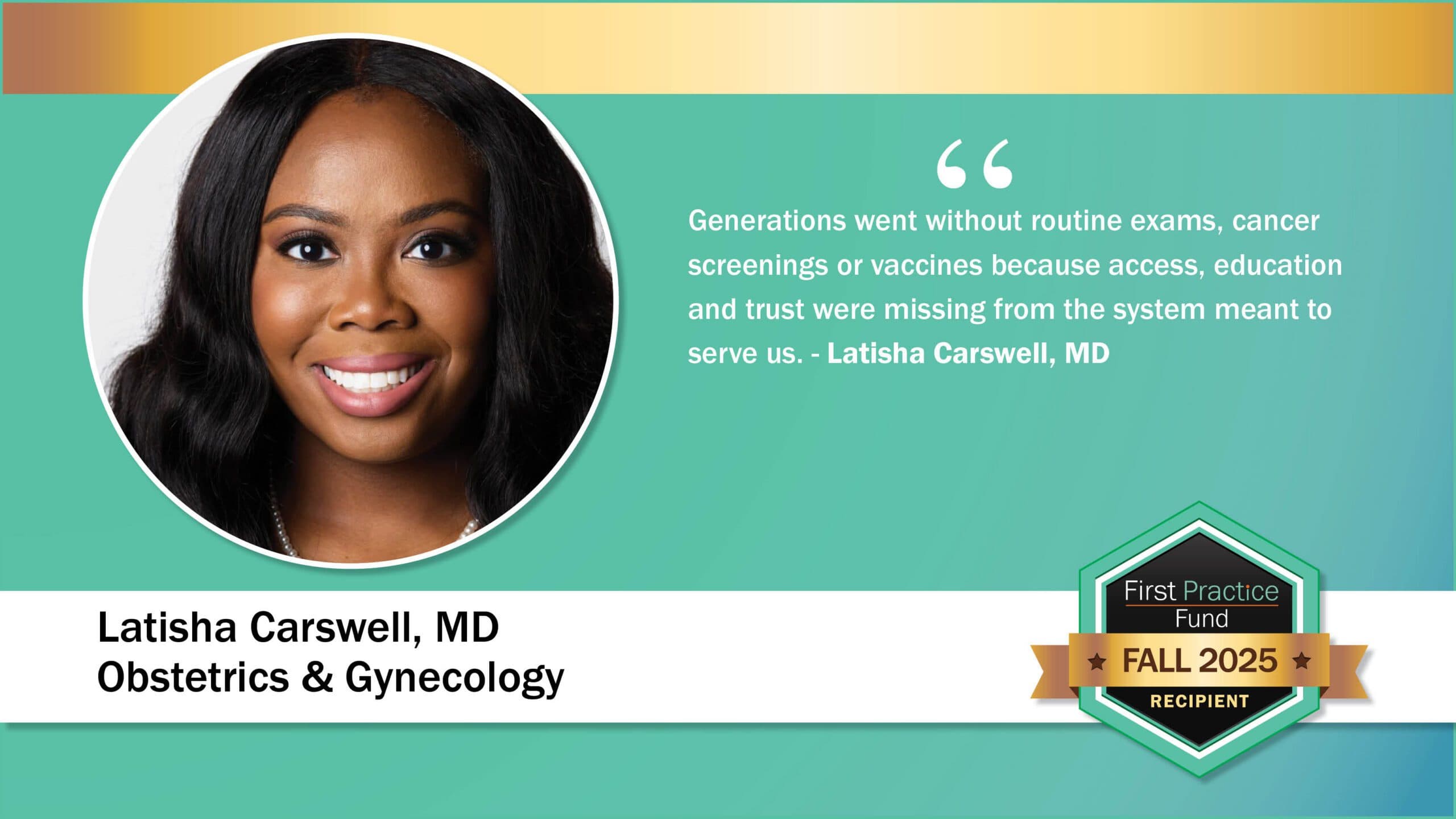
Meet Latisha Carswell, First Practice Fund recipient
If information is power and healthcare is vitality, access to healthcare and timely health information is the quiet force that can redefine a community’s destiny. On a powerful journey of self-determination, Dr. Latisha Carswell aims to be that force in rural, underserved communities, particularly the one she grew up in.
Dr. Carswell is one of nine recipients of PracticeLink’s Fall 2025 First Practice Fund, a competitive scholarship which awards $2,500 to aspiring physicians and advanced practice providers. Applications are now being accepted for Spring 2026.
Currently an obstetrics and gynecology resident, Dr. Carswell was recognized for her strong clinical judgment, patient-centered communication and determination to build a practice rooted in access, advocacy and long-term community impact.
Sponsored by Premier Health, the Fall 2025 First Practice Fund used a combination of essay questions and applicant CVs to identify high-caliber medical trainees poised to lead the future of community-based healthcare. Dr. Carswell’s lived experience, passion for health equity and commitment to rural women’s health made her an exceptional choice.
PracticeLink: Describe a time you witnessed or experienced a barrier to healthcare access, how it shaped your perspective on medicine and how you envision addressing such barriers in your future career.
Dr. Latisha Carswell: I grew up in rural Georgia, where healthcare often felt out of reach. My family, like many around us, viewed going to the doctor as something one only did when absolutely necessary. Preventive care wasn’t part of our vocabulary. Generations went without routine exams, cancer screenings or vaccines—not because they didn’t care about their health, but because access, education and trust were missing from the system meant to serve us.
I remember learning about the Human Papillomavirus (HPV) vaccine for protection against cervical cancer. That moment stayed with me as a simple but powerful reminder of how easy it is for someone’s health to fall through the cracks when the system doesn’t reach far enough. Those experiences shaped not only my perspective on medicine, but my purpose within it.
As an OB/GYN resident, I carry stories of women in my family and community into every patient encounter. I see my mother, my grandmother and my younger self in the faces of women who come to clinic with questions that should have been answered years ago. My goal is to change that narrative, and to make preventive care and education the norm, not the exception.
I envision a future where no young girl grows up unaware of her own body, where every woman—regardless of zip code—has access to compassionate, informed and equitable care. Medicine, to me, is not just about treating disease; it’s about breaking cycles, empowering women and creating generational change.
PL: Share an example of meaningful collaboration across a care team. What made it successful, and what did you contribute to it?
DR. CARSWELL: One meaningful collaboration occurred during a busy labor shift when a patient’s fetal heart tracing—the late pregnancy and labor monitoring to track a baby’s heart rate—became concerning. I worked closely with the nurse to reposition the patient, provide fluids and communicate findings to my senior and attending. Because we acted quickly and communicated clearly, the tracing improved and the patient avoided unnecessary intervention. I contributed by staying calm, coordinating the response and keeping everyone updated.
Having cared for the patient throughout the day and performing her labor checks, she trusted me, which directly facilitated communication and reassurance. This experience showed me that even small moments of teamwork and clear communication can have a meaningful impact on patient outcomes.
PL: Describe a professional challenge you faced in training, how you responded and what you learned.
DR. CARSWELL: A professional challenge I faced in training was learning to speak up in fast-paced clinical situations. Early on, I tended to be a little shy and would hesitate to share my thoughts, especially when senior team members were involved. I realized that even if I had less experience, it was important to advocate for my observations and ideas quickly for the safety and care of our patients.
I worked on finding my voice by preparing ahead, practicing concise communication and reminding myself my perspective matters. Over time, I became more confident speaking up during rounds and in critical situations. This experience taught me more than just listening, being a good team member is also about respectfully contributing, trusting your knowledge and speaking up when it matters most.
PL: Share your career goals and explain how First Practice Fund will help you achieve them.
DR. CARSWELL: My career goal is to practice OB/GYN in rural Georgia, near my hometown of Montezuma, where I can provide comprehensive, compassionate care to underserved communities. I hope to address the unique challenges of rural medicine, including limited resources and access to care, while building long-term relationships with patients and their families. Ultimately, I aim to combine clinical excellence with advocacy, education and community engagement to improve maternal and women’s health in the region I call home.