
 Share
Share- Export to PDF
 Listen
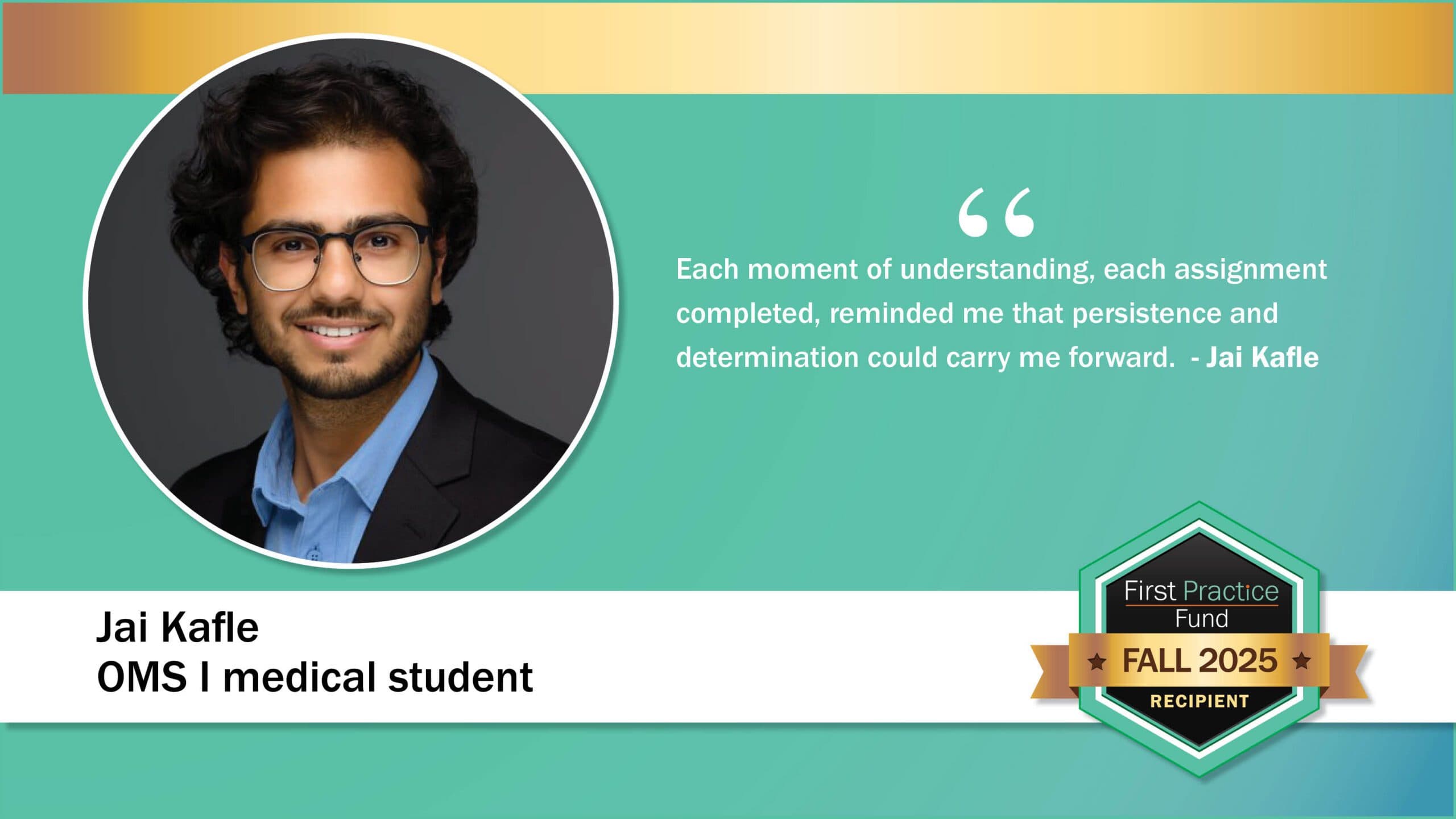
Meet Jai Kafle, First Practice Fund recipient
Every year, millions of patients feel unheard, misunderstood or simply unable to communicate what they need. The doctor across from them may be brilliant. However, brilliance alone cannot bridge a language barrier, earn the trust of a trauma survivor or make a frightened refugee feel seen. What those patients need — what medicine has always needed — are physicians who bring lived understanding with their clinical skill. Jai Kafle is training to be exactly that kind of doctor.
As a first year medical student (OMS I) at West Virginia School of Osteopathic Medicine, Jai is one of nine recipients of PracticeLink’s Fall 2025 First Practice Fund, a competitive scholarship which awards $2,500 to aspiring physicians and advanced practice providers. Applications are now being accepted for Spring 2026.
Sponsored by Premier Health, the Fall 2025 First Practice Fund used a combination of essay questions and applicant CVs to identify high-caliber medical trainees poised to lead the future of community-based healthcare. Jai Kafle’s heartfelt answers reveal a strong determination to succeed.
PracticeLink: Describe a time you witnessed or experienced a barrier to healthcare access, how it shaped your perspective on medicine and how you envision addressing such barriers in your career.
Jai Kafle: In 1993, Bhutan’s ruling aristocrats initiated a campaign to “purify” the nation under the “One Kingdom, One People” doctrine, which resulted in the forced exile of more than 105,000 ethnic Nepalis, including my family. We found refuge in camps in Nepal, where I was born. These camps were managed by United Nations High Commissioner for Refugees (UNHCR) and were not only shelter but also where I first began to dream of becoming a physician. Growing up in that environment shaped my identity and inspired my desire to serve others who face barriers to care.
Life in the camp was difficult. The huts were built from bamboo and thatch and could easily be destroyed by floods or fire. During monsoon season, the nearby river often overflowed and washed away what little we had. When fires started, entire sections of the camp would burn in a matter of minutes. My family often made hard choices, like eating only once a day so that my siblings and I could have just a little more. It was in those moments, sitting together in a makeshift shelter, that I learned about resilience and the strength it takes to keep going.
Sickness was common in the camp. Clean water and sanitation were limited, encouraging diseases like cholera, dysentery and malaria to spread quickly. When one of my close friends fell sick with dysentery, his family could not afford to travel to the hospital several miles away. By the time help arrived, he had passed away. I still remember how completely helpless I felt. That was when I realized his death did not happen because there was no cure but because care was out of reach. That experience stayed with me and became a defining moment for me want to dedicate my life to helping others who face similar barriers.
Over time, I began to see the problem was not only about illness, but about the systems that make healthcare inaccessible. I wanted to be part of the solution to bring care to people who are often forgotten. These experiences taught me that healthcare should not be something that only certain people can afford or reach. It should be a basic human right for everyone.
In 2012, my family was resettled in the United States. While we finally had stability and safety, I soon realized barriers still existed, only in different forms. My parents struggled to communicate with doctors because of language and cultural differences. I often translated for them during medical appointments and helped fill out forms. I saw how easily miscommunication could lead to confusion or mistrust between patients and providers. Even though hospitals were nearby, access was nonetheless limited by understanding and connection.
My family’s health challenges continued: my mother’s spinal surgeries and my father’s cardiovascular and mental health issues. The care we received in the U.S. showed me what compassionate and patient-centered medicine looks like. It reminded me why I wanted to become a doctor in the first place.
Reflecting on my family’s journey, from exile in Bhutan to the refugee camps in Nepal, and finally to resettlement in the United States, I have come to see that my dream of becoming a physician is not just my own. It is also my parents’ dream, who gave up everything for our future, and the dream of my community, many of whom are still waiting for access to care and understanding.
As a future physician, I want to work with underserved populations to make healthcare more accessible and culturally sensitive. I hope to focus on improving trust between patients and providers by listening to patients’ stories, understanding their cultural backgrounds, and addressing the unique challenges they face. I want to be involved in community-based clinics that reach those who often fall through the cracks of the healthcare system. My goal is to ensure that every patient, no matter where they come from or what language they speak, feels understood and cared for. My past has shown me that medicine is not only about treating illness but also about giving people hope and dignity. That is the kind of physician I aspire to become.
PL: Share an example of meaningful collaboration across a care team. What made it successful, and what did you contribute to it?
JK: My journey in healthcare began as a caregiver for my father, whose physical disabilities and mental health challenges were shaped by decades of trauma. He was forced to flee ethnic cleansing in Bhutan and spent 21 years in a refugee camp in Nepal, where scarcity, illness and the loss of a child to a preventable disease affected his life profoundly. Even after we resettled in the United States, his health problems remained connected to that trauma, making his care complex and requiring coordination across several providers. Helping him manage appointments, medications and follow-up care taught me how important it is for every member of a care team to understand the whole story of a patient.
I saw this kind of teamwork in action while volunteering with the Bhutanese-Nepali Community of Central Ohio. I worked with elders who were taking medications meant for their family members for high blood pressure without realizing the risks. This behavior came from a mix of limited health knowledge and mistrust because of past experiences. Helping them safely required working together with interpreters, clinic staff and community leaders. My role was to connect everyone, listen to the elders’ concerns, explain the risks in ways that made sense to them and coordinate follow-up care.
The collaboration worked well because everyone brought something important. Interpreters made sure people could communicate clearly, clinic staff provided medical guidance and community leaders helped build patient trust. My contribution was to bring all these pieces together, share cultural context, advocate for understanding and help navigate barriers caused by past trauma. This experience showed me empathy, patience and clear communication can make a real difference in healthcare, especially for vulnerable communities. It also reinforced that good care is not just about medicine, but about partnership, trust and helping patients navigate a system that can often feel overwhelming.
PL: Describe a professional challenge you faced in training, how you responded and what you learned.
JK: When I came to the United States at fourteen, I faced one of the hardest challenges of my life. I had to learn everything: school subjects, social norms and the language itself at the same time. Every day felt like I was starting over, trying to keep up with classmates who had grown up with years of schooling and fluency in English. Reading textbooks, understanding lectures and completing assignments all required more effort than I had ever imagined. There were times I felt frustrated and discouraged, wondering if I would ever be able to succeed.
Even in those moments, I held onto my lifelong goal of becoming a physician. I spent hours after school practicing English, reviewing science concepts and asking questions whenever I could. I relied on teachers, mentors and classmates for guidance. Bit by bit, I built the skills I needed. Each moment of understanding, each assignment completed, reminded me that persistence and determination could carry me forward, even when the path was not easy.
This experience taught me resilience, patience and a willingness to seek help are just as important as knowledge. It also gave me a deep understanding of what it feels like to face barriers in learning, which has shaped how I approach challenges and how I hope to care for patients in the future. Overcoming this challenge was more than an academic achievement. It strengthened my belief in myself and showed that with focus and effort, even the most difficult obstacles can be turned into opportunities for growth.
PL: Share your career goals and explain how First Practice Fund will help you achieve them.
JK: My career goal is to become a physician who ensures that healthcare is not a privilege but a right for everyone, especially for communities that face systemic barriers. Growing up, I experienced how lack of access to basic resources, education and medical care can shape a person’s life. Being born in a refugee camp, seeing friends and family suffer from preventable illnesses, and later navigating the complex healthcare system in the United States gave me a unique perspective on the profound inequities that exist in medicine. These experiences shaped not only my motivation to pursue medicine but also the kind of physician I hope to become. I want to provide care that is patient-centered, culturally informed and trauma-sensitive. I envision working with underserved populations to ensure they can access care that respects their backgrounds and experiences. I also hope to address gaps in health education and literacy, helping patients feel empowered to make decisions about their health. My goal is to combine compassion, advocacy and clinical skill to build trust and restore dignity in healthcare for those who have long been underserved. I want to be a physician who listens attentively, understands each patient’s context and works closely with individuals and communities to address their needs. I hope to transform my own experiences of hardship and resilience into a career dedicated to equity, hope and healing for others.