
Meet Dr. Olga Pudovka Gross, First Practice Fund recipient
By PracticeLink February 27, 2026
 Share
Share- Export to PDF
 Listen
Meet Dr. Olga Pudovka Gross, First Practice Fund recipient
The history of conflict is often written in loss, but for those with a destiny tied to medicine, it is also written in a fierce, inherited resilience. Family medicine doctor, Olga Pudovka Gross, seeks to channel her family’s multi-generational legacy of enduring wars into a medical career defined by empathy and resolve.
Dr. Gross is one of nine recipients of PracticeLink’s Fall 2025 First Practice Fund, a competitive scholarship that awards $2,500 to aspiring physicians and advanced practice providers. Applications are now being accepted for Spring 2026.
In her application, Dr. Gross described how her family’s legacy abroad and experiences as a resident serving underserved communities within the U.S. had a profound impact on her commitment to patient care.
Premier Health sponsored the Fall 2025 scholarship, explaining their “dedication to advancing medical education and supporting future clinicians aligns seamlessly with the mission of the First Practice Fund.” Dr. Gross was recognized for her dedication, lived perspective, clinical expertise and commitment to deliver lifesaving, equitable care in communities that need it most.
PracticeLink: Describe a time you witnessed or experienced a barrier to healthcare access, how it shaped your perspective on medicine and how you envision addressing such barriers in your career.
Dr. Olga Pudovka Gross: During my first months as a family medicine resident in a rural New Mexico clinic, I met a middle-aged woman who had traveled over two hours for care. She had delayed seeking help because she lacked reliable transportation and feared the cost of care. By the time she arrived, her condition had progressed to a surgical emergency. What struck me most was not just clinical severity but the quiet resignation in her voice, as if she had come to expect care to always be out of reach.
That encounter reshaped how I view medicine. More than a science, medicine is a healthcare system that must earn trust. I realized barriers to access are not always obvious. Sometimes, they are quiet, cumulative and deeply rooted in socioeconomic realities. In rural settings geography, poverty and systemic fragmentation converge to make even basic care feel unattainable.
My perspective is also shaped by my Ukrainian heritage, where resilience is woven into every story. My great grandfathers died in WWII and my family continues to help in the current Ukrainian war that began with the annexation of Crimea in 2014. Their sacrifices have taught me dignity and care are not luxuries; they are rights worth fighting for. That legacy fuels my commitment to medicine as a form of service and justice.
As I move forward in my career, I envision addressing these barriers through clinical excellence and structural advocacy. I plan to pursue a fellowship in emergency medicine, where timely intervention can be lifesaving, especially for underserved populations. I also hope to mentor future clinicians in recognizing and responding to access disparities with empathy and action.
PL: Share an example of meaningful collaboration across a care team. What made it successful, and what did you contribute to it?
DR. GROSS: During my adult inpatient rotation, I was part of the care team managing a middle-aged patient admitted for sepsis secondary to a diabetic foot infection. The team included an attending physician, infectious disease consultant, wound care nurse, physical therapist, dietitian, pharmacist, case manager and me.
What made the collaboration successful was clear communication, mutual respect and a shared urgency to stabilize the patient while planning for long-term recovery. I contributed by:
- Synthesizing clinical data during rounds to present a concise, evolving picture of the patient’s status.
- Coordinating with the wound care nurse to ensure timely debridement and dressing changes.
- Following up with pharmacy to reconcile antibiotics and adjust dosing based on renal function.
- Initiating a conversation with case management about discharge planning and home health needs.
I also took the initiative to speak directly with the patient and family, translating the medical plan into understandable terms and reinforcing the importance of outpatient follow up. That helped build trust and ensure smoother transitions of care. This experience taught me collaboration is not just about sharing tasks but also about advocating for the patient across disciplines.
PL: Describe a professional challenge you faced in training, how you responded and what you learned.
DR. GROSS: One challenging moment in my first year of residency was during a busy outpatient clinic. I was managing a patient with poorly controlled hypertension who became visibly frustrated when I recommended medication adjustments. He felt previous providers did not listen to him and was skeptical of medical advice. Initially, I felt caught between time constraints and the need to build trust. Rather than rushing through the encounter, I paused, acknowledged his concerns and asked open-ended questions to understand his perspective. I learned he was worried about side effects and had difficulty affording medications.
I responded by validating his experience and reframing the conversation around shared goals, collaborating with pharmacy to identify cost-effective options and scheduling a follow up to reinforce continuity and show commitment.
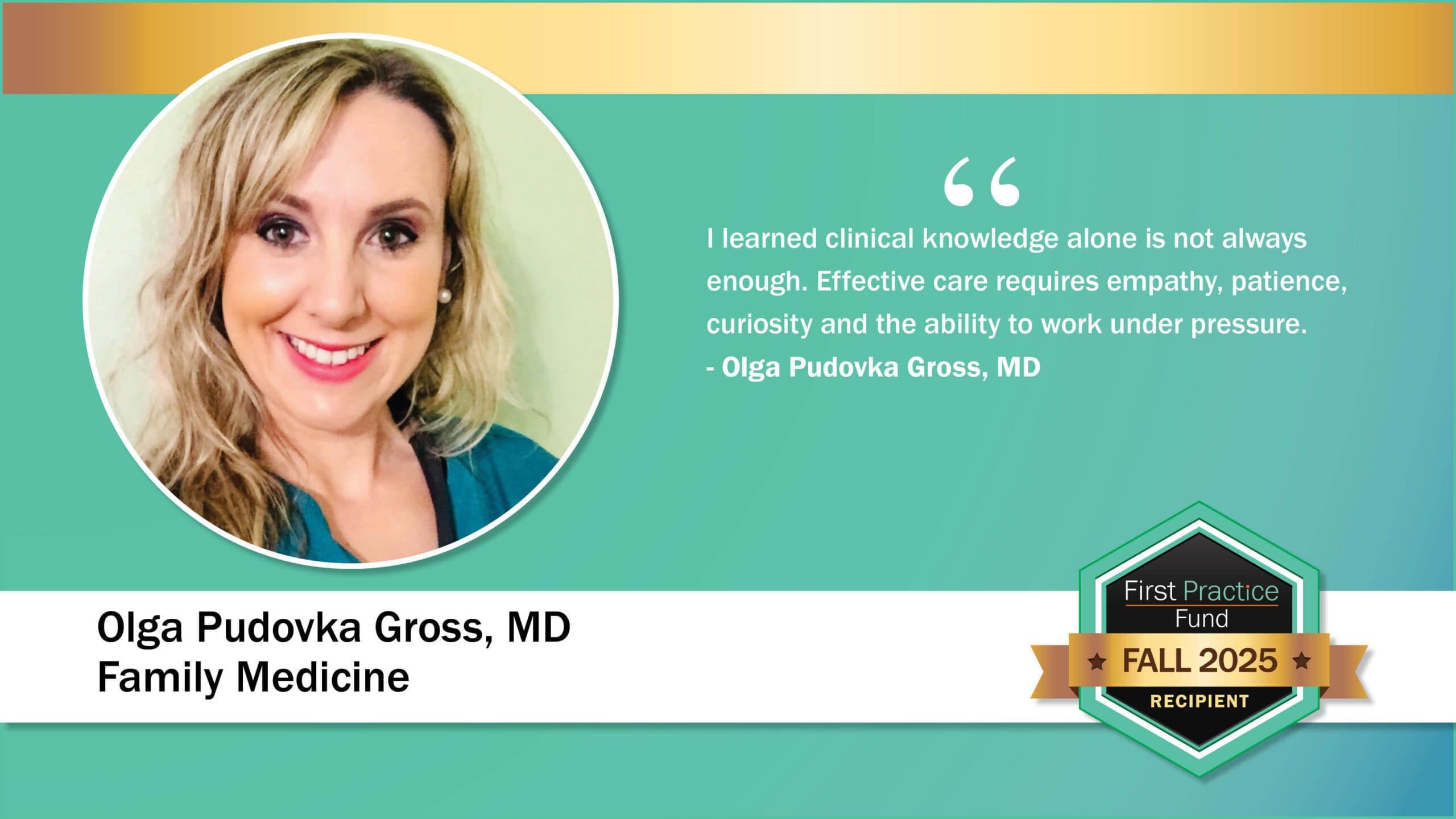
What I learned was clinical knowledge alone is not always enough. Effective care requires empathy, patience, curiosity and the ability to work under pressure. That encounter deepened my appreciation for the relational aspect of family medicine and strengthened my confidence in navigating difficult conversations.
PL: Share your career goals and explain how First Practice Fund will help you achieve them.
DR. GROSS: My career goal is to become a compassionate, skilled emergency medicine physician who brings the breadth of family medicine training into acute care settings, especially in rural and underserved communities. As a family medicine resident, I have developed a strong foundation in whole-person care, continuity and clinical versatility. I am planning to pursue a fellowship training in emergency medicine to deepen my procedural expertise, sharpen my critical decision-making and prepare for high-acuity environments where timely, empathetic care can make all the difference. I am especially drawn to the intersection of equity and access in emergency care. I want to be the kind of physician who not only stabilizes patients in crisis but also advocates for systems that support them beyond the ER. My long-term vision includes mentoring future clinicians, contributing to structural change in healthcare delivery and continuing to grow as both a leader and a learner in dynamic, high-pressure settings.