
 Share
Share- Export to PDF
 Listen
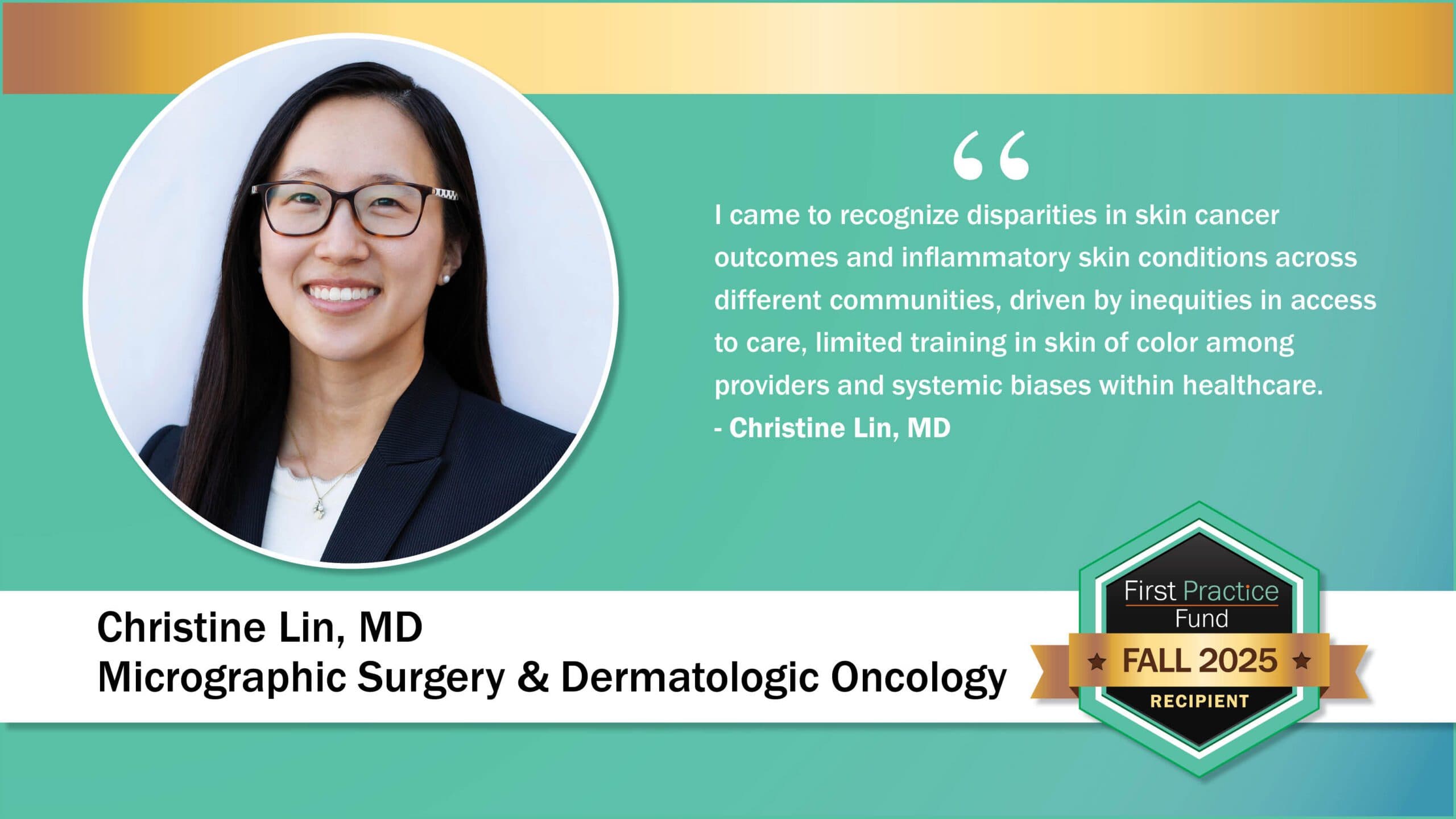
Meet Dr. Christine Lin, First Practice Fund recipient
For years, physicians and patients alike have described how the U.S. healthcare system fails people. After witnessing inequities while in medical school, Christine Lin, MD—a recipient of PracticeLink’s Fall 2025 First Practice Fund—challenged herself to build a practice explicitly designed to reach patients most likely to fall through the cracks.
Now completing a micrographic surgery and dermatologic oncology fellowship at UC San Diego, Lin is one of nine recipients of the $2,500 scholarship, which was sponsored by Premier Health.
First Practice Fund is a competitive scholarship program awarded to emerging medical providers who demonstrate exceptional promise and a clear vision for their future practice. Lin was recognized as a clinician whose personal history, collaborative instincts and research agenda point in the same direction. Applications are now being accepted for Spring 2026.
Describe a time you witnessed or experienced a barrier to healthcare access.
During medical school in Lubbock, TX, I witnessed underinsured, uninsured and underserved communities without consistent access to medical care. At the time, I was part of the leadership team of The Free Clinic, a student-led clinic that provided medical, dermatologic, mental health and physical therapy services to uninsured patients every Wednesday night. Each week, I met patients with significantly elevated blood pressure or blood glucose levels after running out of medications due to job insecurity or losing refrigeration for insulin when their electricity was shut off.
I also vividly recall a patient experiencing housing insecurity who presented with a large, bleeding basal cell carcinoma on his left cheek that had become inoperable due to its size and other socioeconomic barriers. Our team worked closely with Patient Assistance Programs to obtain essential medications at no cost, including insulin and metformin for diabetes and Vismodegib for locally advanced basal cell carcinoma.
How did it shape your perspective on medicine?
These early dermatologic experiences shaped both my pursuit of dermatology and passion for health equity. I came to recognize disparities in skin cancer outcomes and inflammatory skin conditions across different communities, which are driven by inequities in access to care, limited training on different skin colors among providers and systemic biases within healthcare.
How do you envision addressing healthcare barriers in your future career?
In the future, I hope to practice dermatologic surgery and general dermatology at a rural center or clinic where I can continue serving underserved, vulnerable and medically complex patient populations while advocating for their care and needs. I also aspire to hold a teaching position that allows me to support local nonprofit organizations and student-run free clinics in providing care for patients navigating difficult transitions. Additionally, I value working in a team setting where I can collaborate with social workers and case management to address patients’ broader needs (transportation, housing and financial barriers) so they can make the best healthcare decisions possible in a safe and supportive environment.
Share an example of a meaningful collaboration across a care team.
As a first-year dermatology resident at my VA continuity clinic, I worked closely with co-residents to support one another and provide consistent, high-level care to our veterans. On days when one of us fell behind with a complex patient or had an unexpected urgent walk in, the others stepped in to keep the clinic running effortlessly. In these moments, I stepped in and filled in gaps wherever the clinic needed support, whether by seeing patients from another panel, coordinating with consultants such as Plastics or the FNA team or helping expedite diagnostics for high-risk skin cancer patients.
What made it successful and what did you contribute?
On excision and procedure days, we also worked together seamlessly. When one of us was in surgery and an inpatient consult came in, the resident who was assisting in surgery would step away to handle the patient consult, even if they were not on call. Other times, we offloaded administrative tasks from each other so the resident who was operating could focus on their procedure and complete it safely.
Our team’s ability to communicate openly, stay aware of each other’s needs and take accountability for shared responsibilities allowed us to prioritize and deliver comprehensive, safe patient care while creating a collaborative and engaging learning environment.
Describe a professional challenge you faced in training, how you responded and what you learned.
During residency, while I was rotating on the inpatient dermatology consult service, I worked with a colleague who was somewhat less familiar with the hospital system. This occasionally led to inefficiencies, including delays in communicating with consulting teams, documentation, placing orders or performing biopsies. To ensure we provided safe and efficient patient care, it became important for me to support my colleague in becoming more comfortable with the protocols while sharing responsibilities.
Early on, I worked closely with them to explain my overall approach to consults, from chart review and patient evaluation to placing orders and communicating effectively with teams. Before pre-rounding, we would work together to triage our sickest patients and ensure all diagnostics were in place before meeting with our attending physician. We also began holding end-of-day debriefs to reflect on what went well and other ways we could continue improving our teamwork.
This collaborative and transparent approach helped us become more efficient, reduce lapses in care and strengthen our team dynamics, ultimately allowing us to provide a high level of care to our patients. Through this experience, I learned the value of addressing challenges early, communicating openly and adapting my leadership style to support teammates while still prioritizing patient care.
Share your career goals and how First Practice Fund will help you achieve them.
My career goals include:
Expanding on-site Mohs micrographic surgery within the Veterans Health Administration at Veterans Affairs Medical Centers/Clinics to increase accessibility and continuity of care for veteran patients.
Collaborating with colleagues on research initiatives, specifically: 1) investigating outcomes of skin cancers in immunosuppressed patients treated with surgical, topical and/or systemic modalities to delineate optimal therapeutic approaches, and 2) investigating access/barriers to care and outcomes of skin cancer in underserved and vulnerable patient populations (i.e., underrepresented minorities, veterans) and implementing targeted interventions to address disparities.
Mentoring aspiring dermatologic surgeons/dermatologists, particularly underrepresented minority trainees through informal or formal mentorship (e.g., ACMS Diversity Mentorship Program, ASDS Rise Up Mentorship Program), while also mentoring/teaching at student-run free clinics to provide dermatologic care for uninsured patients.